
Sports Betting 101
How Sports Betting Odds Work
Learn how American, decimal, fractional, and percentage odds express the same betting price, how to calculate profit and total return, where sportsbook margin appears, and why odds move.
This guide will explain:
- What sports betting odds tell you about price, probability, and potential return
- How American, decimal, fractional, and percentage odds work
- How to calculate profit and total return from the odds you see
- Why sportsbook prices, spreads, and totals move before an event starts
Betting Odds 101
When you open a sportsbook, you will usually see several pieces of information presented together rather than odds on their own. A spread bet might look something like the example below:

Each part of that quote tells you something different about the wager:

This guide concentrates on the odds portion of sportsbook pricing, while also showing how odds interact with betting lines later in the article.
What Are Betting Odds?
Sports betting odds are the price attached to a wager. Every time a sportsbook offers a market, it assigns a price to each available selection. That price tells you how much you can win relative to the amount you stake.
Odds also reflect how likely an outcome is being priced. Outcomes with a higher implied probability offer a smaller potential profit for the same stake, while outcomes with a lower implied probability offer a larger potential profit.
What Do Sports Betting Odds Tell You?
Sports betting odds tell you the terms being offered on a specific selection. To read them properly, you need to look at the selection, the market, and the price together.
The odds themselves do not change based on how much you stake. They establish the ratio between risk and potential return, while your stake determines the actual dollar amounts.
Using American Odds, at +150:
- A $10 stake produces $15 in potential profit
- A $20 stake produces $30 in potential profit
- A $100 stake produces $150 in potential profit
The proportion stays the same in every case.
Odds also express the probability built into that price. A +150 price corresponds to a 40% implied probability.
Betting markets often describe prices as longer or shorter odds:
- Longer odds offer more potential profit for the same stake and represent a lower implied probability
- Shorter odds offer less potential profit and represent a higher implied probability
For example, +200 is longer than +150, while -200 is shorter than -150.
This gives you one common way to compare how sportsbooks are pricing different outcomes, even across different sports and markets.
Types of Sportsbook Odds
The same sportsbook price can be written in several formats. Each emphasizes a different part of the same relationship.
American odds are the standard format on U.S. sportsbooks. Decimal and fractional formats are common internationally, while percentage displays have become more familiar as prediction markets have grown in popularity and implied probability has become more visible in betting interfaces.
| Format | What it emphasizes | Example |
|---|---|---|
| American odds | Profit or stake relative to $100 | +150 |
| Decimal odds | Total return per unit staked | 2.50 |
| Fractional odds | Profit relative to stake | 3/2 |
| Percentage / implied probability | Probability represented by the price | 40% |
Even though they are represented in different ways, the four examples above all represent the same underlying price.
How American Odds Work
American odds are built around a $100 reference point. They use a plus or minus sign to tell you how to read the price.
- Plus (+) odds show how much profit you would make from a $100 stake.
- For example, +150 means a $100 bet would make $150 in profit.
- For example, +150 means a $100 bet would make $150 in profit.
- Minus (-) odds show how much you would need to stake to make $100 in profit.
- For example, -150 means you would need to bet $150 to make $100 in profit.
At +100, the two amounts are equal: a $100 stake makes $100 in profit. This is known as even money.
You do not need to bet exactly $100 or $150. Those amounts are simply the reference points used to express the odds. Once you understand what the sign means, the same price can be scaled to any stake.
Positive American Odds
With positive American odds, the number tells you how much profit a $100 stake would make. The higher the positive number, the more profit you receive for the same stake.
That also means the odds are getting longer. For example, +200 is longer than +150 because it offers a larger potential return and represents a lower implied probability.
| Price | $20 stake | $50 stake | $100 stake |
|---|---|---|---|
| +120 | $24 profit | $60 profit | $120 profit |
| +150 | $30 profit | $75 profit | $150 profit |
| +200 | $40 profit | $100 profit | $200 profit |
The relationship scales directly with your stake. At +150, your potential profit is always 1.5 times the amount you risk.
For the same selection, a higher positive price is better for you. If one sportsbook offers +150 and another offers +130 on an otherwise identical wager, +150 pays more for taking the same risk.
Negative American Odds
With negative American odds, the number tells you how much you need to stake to make $100 in profit. As the number moves farther below zero, you have to risk more money to make the same amount.
That means the odds are getting shorter. A price of -200 is shorter than -150 because it offers less profit relative to the amount you stake and represents a higher implied probability.
| Price | For $20 profit | For $50 profit | For $100 profit |
|---|---|---|---|
| -120 | $24 stake | $60 stake | $120 stake |
| -150 | $30 stake | $75 stake | $150 stake |
| -200 | $40 stake | $100 stake | $200 stake |
For the same selection, a negative price closer to zero is better for you. At -120, you risk $120 to make $100. At -200, you risk twice your stake to win the same $100.
You will often see -110 on spreads and totals because sportsbooks traditionally price balanced two-sided markets with 10 cents of juice on each side.
Instead of risking $100 to win $100 at even money, you risk $110 to win $100. That extra $10 is the vig built into the price.
Why Equal Moves in American Odds Are Not Equal

American odds are very good at telling you the payout terms of a wager, but they are a poor scale for judging how far apart two probabilities are. The numbers are not linear.
For example, moving from +150 to +100 changes the implied probability from 40% to 50%, a 10-percentage-point move. Moving from -150 to -200 may look like the same 50-point change on the screen, but the implied probability moves from 60% to 66.67%, only 6.67 percentage points.
That is why I use American odds to answer what am I being paid?, but I switch to implied probability when I want to answer how is this outcome being priced? After years of looking at betting boards, that separation is much more useful than trying to develop an instinct for whether two American numbers merely look close together.
How Decimal Odds Work
Decimal odds show the total return for each unit staked, including the original stake. The whole decimal number is the return multiplier.
1.00 represents your returned stake. Everything above 1.00 represents profit.
The calculation is:
Total return = stake × decimal odds
A few common prices make the format easy to read:
| Decimal odds | $20 total return | $20 profit |
|---|---|---|
| 1.50 | $30 | $10 |
| 2.00 | $40 | $20 |
| 2.50 | $50 | $30 |
| 3.00 | $60 | $40 |
Decimal odds are useful because the number on the screen is already a return multiplier. For the same selection, 2.60 is better than 2.50 because every dollar staked has a larger potential return.
How Fractional Odds Work
Fractional odds show potential profit relative to stake.
The numerator represents the potential profit relative to the amount represented by the denominator:
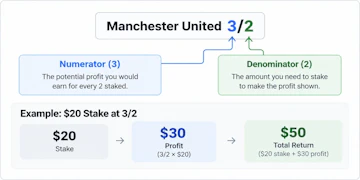
As seen in the example above, the format can be read directly as a ratio:
| Fractional odds | What the price means | Example result |
|---|---|---|
| 3/2 | $3 profit for every $2 staked | $20 stake → $30 profit |
| 1/2 | $1 profit for every $2 staked | $20 stake → $10 profit |
| 10/11 | $10 profit for every $11 staked | $22 stake → $20 profit |
A price above 1/1 is called odds-against because the potential profit exceeds the stake. A price below 1/1 is odds-on because the potential profit is smaller than the stake.
The most useful reading method is simply to treat the fraction as the profit-to-stake ratio. 3/2, for example, is the same underlying price as +150 American, 2.50 decimal, and 40% implied probability.
How Percentage Odds and Implied Probability Work
Percentage odds put the probability represented by a sportsbook price into a format that is immediately familiar.
Instead of seeing +150, you can express the same price as 40% implied probability. The percentage is not a different wager or pricing system. It is another way of interpreting the odds.
This can be useful because American odds are designed around payout ratios, while percentages answer a different question more directly: what probability does this price represent?
Percentage-style pricing has become more familiar as prediction markets have grown, but implied probability is equally useful when reading sportsbook odds. Some betting interfaces also surface probability alongside traditional prices.
Implied probability tells you what probability is encoded in the price, not what the true probability of the event happening actually is.
If you believe the probability of something happening is higher than what the price implies, then you have found yourself a value bet.
What Percentage Odds Mean
Implied probability is the probability represented by the sportsbook's listed price.
| American odds | Implied probability |
|---|---|
| +200 | 33.33% |
| +100 | 50% |
| -150 | 60% |
| -200 | 66.67% |
As implied probability rises, the potential return falls. An outcome priced at 66.67% costs more to back than one priced at 33.33%, so the sportsbook offers a smaller potential profit relative to your stake.
Converting odds to percentages also gives you one common scale for comparing very different-looking prices. If one source shows 2.50 decimal and another shows +150 American, converting both to 40% immediately shows that they represent the same price.
The percentage is the probability encoded by the listed odds. It is not necessarily the market's margin-free estimate of the outcome because sportsbook prices contain vig. That becomes important when you add the implied probabilities of every selection in a market, which we will cover shortly.
Converting Betting Odds Into Implied Probability
I use implied probability because it gives every price the same language. +175, -135, 2.15, and 8/5 look completely different on the page, but once they are converted into percentages I can compare what each price is actually saying much faster.
The most practical way to read that percentage is as a break-even rate:
At -110, the implied probability is 52.38%, which means you need to win about 52.38% of wagers made at that price to break even over time. At +150, the break-even rate is 40%.
From there, I look at the market around the price. Sportsbook implied probabilities include margin, so if one side converts to 56% and the other to 48%, I do not treat those as two clean probability estimates. They add to 104%, which tells me part of what I am seeing is sportsbook margin.
That is where percentages become genuinely useful. They let me ask two separate questions: what win rate does this price require to break even, and how much margin is built into the overall market?
How to Calculate Profit and Total Return
The cleanest way to read any payout is to keep three quantities separate:

The way to calculate profit changes slightly by odds format, but equivalent prices always produce equivalent returns.
American odds require different formulas on either side of zero:
| Price type | Profit formula | $20 example |
|---|---|---|
| Positive | Stake × odds ÷ 100 | +150 → $30 profit |
| Negative | Stake × 100 ÷ absolute odds | -150 → $13.33 profit |
Add the original stake to find total return. That makes the +150 example $50 total return, while the -150 example returns $33.33.
The $100 reference is also a useful mental check. +150 means $100 makes $150; -150 means $150 makes $100. If your calculated result does not roughly fit that relationship, check the arithmetic.
Decimal odds give you the total return directly:
Total return = stake × decimal odds
A $20 stake at 2.50 returns $50 total, leaving $30 profit after the stake is removed.
For profit only, use:
Profit = stake × (decimal odds - 1)
With fractional odds written as A/B:
Profit = stake × A ÷ B
A $20 stake at 3/2 makes $30 profit and returns $50 total. At 1/2, the same stake makes $10 profit and returns $30 total.
The fraction itself already contains the profit-to-stake ratio, so there is no additional conversion required.
A probability can be converted directly into decimal odds:
Decimal odds = 1 ÷ implied probability
Write the percentage as a decimal first. At 40%, the calculation is 1 ÷ 0.40 = 2.50. A $20 stake at that price therefore returns $50 total, including $30 profit.
At 60%, the equivalent decimal price is 1.67, so a $20 winning stake returns approximately $33.33, including $13.33 profit.
Percentage odds therefore do not require a separate payout system. The percentage gives you the implied probability, which can be translated back into the same price used by the other formats.
Sports Betting Odds Conversion and Payout Reference
The table below brings the major formats together. Profit and total return use a $20 stake.
| American | Decimal | Fractional | Implied probability | Profit on $20 | Total return |
|---|---|---|---|---|---|
| +200 | 3.00 | 2/1 | 33.33% | $40.00 | $60.00 |
| +150 | 2.50 | 3/2 | 40.00% | $30.00 | $50.00 |
| +120 | 2.20 | 6/5 | 45.45% | $24.00 | $44.00 |
| +100 | 2.00 | 1/1 | 50.00% | $20.00 | $40.00 |
| -110 | 1.91 | 10/11 | 52.38% | $18.18 | $38.18 |
| -120 | 1.83 | 5/6 | 54.55% | $16.67 | $36.67 |
| -150 | 1.67 | 2/3 | 60.00% | $13.33 | $33.33 |
| -200 | 1.50 | 1/2 | 66.67% | $10.00 | $30.00 |
| -300 | 1.33 | 1/3 | 75.00% | $6.67 | $26.67 |
You do not need to memorize every conversion. The important relationship is that equivalent prices produce equivalent payouts.
Once you can move between price, probability, profit, and return, sportsbook odds become much easier to read. You are no longer looking at an isolated plus sign, minus sign, decimal, fraction, or percentage. You are looking at the terms of the wager.
Why Sports Betting Odds Move
A sportsbook price can move at any point before your wager is accepted because the market is continually being repriced.
Sportsbooks open markets using available information, pricing models, trader judgment, and signals from the broader betting market. As more information and betting activity arrive, those prices can change.
Common drivers include:
- New information: Injuries, confirmed lineups, weather, suspensions, and roster changes can alter the expected outcome
- Betting action: Meaningful demand on one side can cause a sportsbook to adjust its price
- Broader market movement: Sportsbooks react when influential books or the wider market reprices an event
- Risk management: A sportsbook may adjust prices when its exposure becomes concentrated
- Time and limits: Markets often become more informed as an event approaches and more money can be wagered
These factors can overlap. A line might move after an injury report while sophisticated bettors are reacting to the same information and other sportsbooks are adjusting simultaneously.
The visible movement therefore tells you that the market repriced, but not necessarily which single factor caused it.
Odds Move Example
Suppose the Knicks open at +150 and later move to +130.
A $100 stake at +150 offers $150 in potential profit, while the same stake at +130 offers $130.
If you placed and had +150 accepted before the move, your fixed-odds ticket remains +150. The new +130 price applies to wagers placed afterward.
The reverse can happen too. If you took +150 and the market later moved to +180, the later price would have offered a larger return for the same outcome.
Whether the Knicks eventually win is a separate question from whether +150 was a strong or weak entry price.
Price Movement vs. Line Movement
A sportsbook can change the price attached to a market, the spread or total itself, or both. Those changes affect your wager in different ways.
Consider an Eagles spread that opens at Eagles -3.5 (-110).
If it moves to Eagles -3.5 (-120), the spread has not changed. You still need Philadelphia to cover 3.5 points, but the wager has become more expensive. At -110, $110 makes $100; at -120, you need $120 to make the same $100.
If the market instead moves to Eagles -4 (-110), the price has stayed the same but the scoring requirement has changed. An Eagles win by exactly four points wins a -3.5 wager but pushes at -4.
The same distinction applies to totals. Moving Over 224.5 (-110) to Over 225.5 (-110) leaves the price unchanged but requires one additional point for the Over to win.
Markets can also move in stages. Eagles -3.5 might first become more expensive at -120 before the sportsbook moves the spread to -4 and returns the attached price closer to -110. Watching both numbers tells you far more than simply saying the line moved.
What I Look for When Odds and Lines Move
When I watch a market move, I separate price movement from number movement because they tell me different things.
A sportsbook can make Eagles -3.5 more expensive by moving -110 to -120 without changing what Philadelphia has to do on the field. Moving the spread from -3.5 to -4 changes the actual result you need.
Sportsbooks also use price movement as part of the path between numbers. You may see -3.5 (-110) become -3.5 (-115), then -3.5 (-120), before the market eventually moves to -4 at a cheaper attached price.
The exact sequence varies by market, but watching both pieces shows you how the sportsbook is repricing the wager rather than reducing everything to “the line moved.”
And not every half-point carries the same weight. In football, moving through a common margin such as 3 can be much more meaningful than moving through a less common margin.
That is why an experienced bettor looks at where the number moved, how the attached price changed, and what game outcomes sit between the old line and the new one. The headline movement alone does not tell the whole story.

JD has been betting since 2009, back when his bookie was a guy named Vin who ran lines out of Philly. He survived the sketchy offshore days (barely) and made the jump to regulated sportsbooks the second New Jersey legalized in 2018. Since then, he’s turned hunting bonuses and exploiting odds boosts into an art form.
These days, JD specializes in helping new bettors skip the rookie mistakes, as well as showing seasoned ones how to play the promo game like a pro. If there’s a bonus to be had or a line that doesn’t look right, JD’s probably already on it.


