
Prediction Markets 101
How Pricing Works in Prediction Markets
Learn what prediction market prices mean, how cents, implied probability, and payout displays work, and why prices move.
This guide is for educational purposes, not legal advice. U.S. rules and enforcement positions can evolve, and availability may vary by state.
Before trading, you should review the rules that apply in your jurisdiction and confirm that any platform you use is authorized to operate in the United States.
This guide will explain:
- What you are buying and selling in a regulated prediction market
- How platforms turn outcomes into tradable contracts that settle to $1 or $0
- How market prices are formed, and why platforms often show percentages first
- How a trade is matched, and why execution can differ from what you expect
- The two ways a position ends: exiting early or holding to settlement
Prediction market pricing is the part that makes the whole product click.
Once you understand what the price is telling you, you stop looking at markets as vague opinion polls and start reading them as tradable contracts with defined risk, defined upside, and a live market value.
In regulated prediction markets, that price is not a final answer and it is not a sportsbook line posted by a house. It is the current level where market participants are willing to trade a contract tied to a real-world outcome.
What is Prediction Market Pricing?
Prediction market pricing is the market’s current valuation of a contract based on a future outcome. That is the cleanest way to think about it.
Take a simple Yes/No contract:
If you buy a Yes contract at 62¢, you are paying $0.62 today for something that will settle at a later date.
If the outcome happens and you hold through settlement, the contract becomes $1.00. If it does not happen, it becomes $0.00.
That means the live price is doing two jobs at once.
- First, it tells you what the market currently thinks the contract is worth.
- Second, it tells you your risk and upside if you trade at that level. Buy at 62¢ and, before costs, your maximum profit is 38¢ per contract and your maximum loss is 62¢ per contract.
What pricing does not do is tell you the final result in advance. A contract can trade at 70¢ today and still settle at $0. It can trade at 25¢ today and later settle at $1.
Beginners often treat the current price as if it were the answer, when really it is the market’s current answer, subject to change until the market closes and resolves by its rules.
How Prediction Market Pricing Works
On regulated platforms, you will usually see prediction market pricing presented in three ways:
- Cents Pricing,
- Implied Probability
- Payout Multiple
They are all different ways of reading the same thing, but they are not equally useful for the same task.
Ultimately, the most important one is cents price, as it is the actual trading price of the contract. It is the number that determines what you pay to enter, what you can receive at settlement, and what price you would need to sell at if you exit early.
Many platforms show implied probability percentage because it is much easier to scan, and payout multiples because they gives a quick sense of potential return relative to entry price.
But those are display layers built around the underlying contract price, not separate systems of pricing. In other words, they are simply different ways of showing the information the cents price already gives.
Cents Pricing
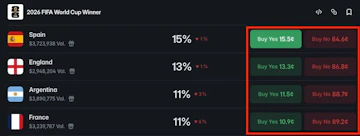
What is Cents Pricing?
The live price of one contract, usually quoted between 1¢ and 99¢. On regulated event-contract platforms, that is the number that determines what you actually pay to enter the trade.
What Cents Pricing is Best for:
Understanding your entry cost, your maximum loss, and your upside if the contract wins.
How to read Cents Pricing:
If a Yes contract costs 32¢, you pay $0.72 per each contract you buy.
If the outcome happens, it settles at $1.00 - earning you $0.28 per contract
If it does not happen, it settles at $0.00
Cents Price Example

- You want to predict that Duke will win the 2026 NCAA Tournament
- You buy 100 Yes contracts at 21¢ each
- If Duke wins it, you receive $0.79 for each contract you own.
- Gross profit before fees = $79
- Max loss if held to settlement and Duke is not the champion = $21
Cents price is the real trading input. Everything else is just another way of expressing the same market.
Implied Probability
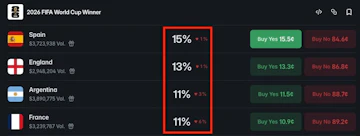
What is Implied probability?
Implied probability is the platform’s percentage view of how likely an outcome is to happen, based on the current market. Platforms often show that percentage on market lists because it is the easiest pricing format for beginners to understand as it answers the most natural question right away:
“How likely does the market think this outcome is?”
If a market shows:
Seattle Seahawks - 58%
New England Patriots - 42%
the platform is showing you the market’s current view of each side’s likelihood.
What is Implied probability best for?
- Quickly scanning markets
- Comparing which side is favored
- Understanding how confident the market is
- Spotting close calls vs long shots
It is the most intuitive format when you are browsing multiple markets and want to understand the landscape fast.
How to read Implied probability:
A higher percentage means the market sees that outcome as more likely.
For example:
- 51% = slight favorite
- 70% = strong favorite
- 90% = heavy favorite
- 25% = clear underdog
Implied Probability ≠ True Probability

Implied probability is not a prediction from an expert panel, and it is not a guaranteed true probability.
It is simply the market’s current view based on available information, trading activity, and sentiment at that moment. That number can change quickly as news breaks, sentiment shifts, or money flows to one side.
No matter how confident the markets may seem of an outcome occuring, markets can be wrong. They can be early. They can be distorted by low liquidity, one-sided trading, or temporary overreaction. So the implied probability should be read as the market pricing the contract around that level right now, not as a guarantee that the event truly has a 62% chance of happening.
Payout Multiple
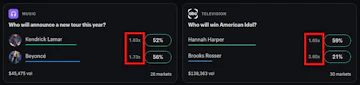
What is Payout Multiple?
A simplified display showing the total return relative to your stake if your contract wins. On Kalshi and other platforms, outcomes are often shown with a payout figure such as 1.90x, 1.23x, or 6.25x.
What Payout Multiple is best for:
Quickly seeing the upside if your pick wins. Aka “If I’m right, what kind of return can I expect on my investment?”.
How to read Payout Multiple:
If a contract shows 1.90x, that means a winning position returns about 1.90 times what you put in, before fees.
Payout Multiple Example

If you stake $100 on an outcome shown at 1.90x:
- Total return if it wins = about $190
- Gross profit before fees = about $90
If another outcome is shown at 4.00x:
- A $100 winning stake returns about $400
- Gross profit before fees = about $300
The lower the contract price, the larger the payout multiple tends to be.
The higher the contract price, the smaller the payout multiple tends to be.
That is why favorites usually show a lower multiplier, while long shots show a bigger one.
How Prices Are Formed on Regulated Prediction Markets
In regulated prediction markets, prices are formed by trading activity between participants. The platform is not operating like a sportsbook that posts odds and takes the other side of your bet. It lists the contract, provides the rules and trading interface, and matches traders when buyers and sellers agree on price.
That is the core reason prediction market pricing feels different from sportsbook pricing. Sportsbooks are house-driven, while Prediction markets are market-driven. Prices are constantly emerging from what people are willing to pay and accept in that market at that moment.
Buyers post bids, sellers post asks, and trades happen when those prices meet. In practice, that is why the displayed market price is not always the exact price you will get. Depending on what the platform shows, you may be looking at the best bid, best ask, a midpoint, or the last traded price.
If you buy immediately, you usually trade near the ask. If you sell immediately, you usually trade near the bid.
That changes the user experience in a practical way. A market can look attractive on the list page and still give you a worse fill than expected if the spread is wide or liquidity is thin. That is also why market orders can be riskier in weaker markets: they prioritize speed over price control, while limit orders let you set the price you are willing to accept.
How Prediction Market Prices Move
Prediction market prices move because the market is constantly repricing the contract.
- The first driver is information. A new poll, report, court ruling, data release, injury update, or weather shift can change how traders assess the outcome, which changes what they are willing to pay.
- The second driver is order flow. Even without major news, price can move because traders buy or sell aggressively enough to consume the available liquidity at the best levels.
This matters because beginners often assume every move is a clean verdict on truth or a change in how likely an event is to happen. Sometimes a move genuinely reflects new information, other times it simply reflects a burst of trading in a thin market. Sometimes it reflects both at once.
Price Movement in Low Liquidity Conditions
Liquidity matters a lot more than most beginners give it credit. In low-liquidity markets, you are more likely to see wider spreads, more slippage, and sharper price jumps from relatively modest trading. A market can still be directionally useful while being awkward to trade well.
You can be right on the final outcome and still hate your entry. You can also be wrong on the final outcome and still profit if the price moves your way and you exit before settlement. Your result depends on where you entered, where you exited, or where the contract eventually settled if you held to the end.

With a background in data analysis and over a decade of DFS and pick’em grinding, Nate lives in the weeds of player matchups, pricing inefficiencies, and market movement, and has built a reputation for spotting micro-edges before the crowd.
Whether it’s NFL, NBA, or MLB, if it involves player performance and real money, Nate’s breaking it down, building models, and finding leverage.
Off the clock, Nate’s either chasing his toddler around the house or deep in a YouTube rabbit hole on zone defense schemes. Sometimes both.


