
DFS 101
Common Pick’em Mistakes Beginners Make
Pick’em mistakes usually happen long before the games begin. They come from weak reasoning, chasing bigger payouts, copying screenshots, or ignoring how the picks fit together.
This guide will explain:
- The most common Pick’em mistakes beginners make before submitting an entry
- Why fixed-payout and peer-to-peer Pick’em formats should not be treated the same
- Why bigger payouts and extra picks usually come with more risk than beginners expect
- How projections, player status, and platform-specific rules affect Pick’em results
- The simple pre-submit checklist that helps beginners avoid the most preventable Pick’em mistakes
Common Pick’em Mistakes Beginners Make
DFS Pick’em is a much simpler game than traditional DFS, and that is a big part of the appeal.
You see a player, a stat line, and a choice: higher or lower. There's no salary cap, no full lineup build, no 150-entry tournament lobby to beat. For beginners, Pick’em can feel like the most straightforward version of fantasy sports.
That simplicity is also where most Pick’em mistakes start.
The beginner errors I see the most are usually are not complicated. They are not about lacking advanced models, deep statistical edges, or a perfect read on every defensive matchup on the slate. Most happen much earlier than that.
If you are still learning how DFS Pick’em works, this guide is the practical cleanup chapter. It is a practical look at where beginners tend to give away value in Pick’em, and how to build entries with a little more patience, context, and discipline.
Mistake 1: Thinking Every Pick’em Entry Works the Same Way
The first mistake is assuming all Pick’em entries work the same way because the interface looks familiar.
That is a beginner trap. Many Pick’em products use similar language: higher, lower, projections, entries, picks, payouts. But the structure underneath can be different. Before judging whether an entry makes sense, you need to know what type of contest you are actually entering.
Pick’em is a rules-based contest, where the format determines how payouts are calculated, how your entry is judged, and sometimes who or what you are competing against.
A beginner might see two entries that look almost identical:
- Jalen Brunson higher than 27.5 points
- Domantas Sabonis lower than 12.5 rebounds
- Tyrese Haliburton higher than 9.5 assists
At first glance, that looks like one basic Pick’em decision: choose higher or lower on three player stat lines.
But the format changes what that entry actually means.
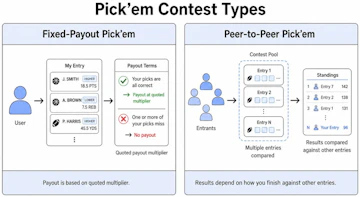
In a fixed-payout Pick’em format, the platform usually shows the payout terms before you submit. If all three picks hit, the entry pays according to the listed payout structure. If one pick misses, you will lose your bet.
In a peer-to-peer Pick’em format, the card is evaluated inside a contest pool rather than against a simple fixed payout. That changes the practical goal significantly: You may need to finish above a cutoff, land in a payout tier, or outperform enough other entries for the result to matter. Even if all your picks are right, you might still not qualify for a payout.
Player picks are only half the decision. The other half is the container those picks live inside.
Why contest type changes your Pick’em decisions

Pick’em formats can differ by payout structure, grading rules, field type, and risk profile.
In fixed-payout Pick’em, the key question is usually whether your selections meet the listed conditions for the payout shown. You are reading the entry against a defined payout ladder: how many picks need to hit, what the payout is, and how misses, ties, or voids affect the result.
In peer-to-peer Pick’em, the question can be different. You may need to understand how your entry performs relative to other users, how the prize pool is distributed, and whether the format rewards simply being correct or being more correct than the field.
That significantly changes the way a beginner should think.
In a fixed-payout entry, beginners should be especially careful about how many picks they add, whether they are choosing a stricter or more flexible entry type, and what the payout actually requires. The listed multiplier or payout is not just your possible reward. It is a clue about difficulty.
In a peer-to-peer contest, beginners also need to understand the field and payout structure. If only the top group of entries receives meaningful payouts, then a safe-looking entry that is merely average may not be enough. If the contest pays a broader group, the decision may feel closer to avoiding obvious mistakes and building a clean, logical card.
The contest type you see in the app may depend on your state. A platform might offer fixed-payout Pick’em in one state, peer-to-peer Pick’em in another, and no paid Pick’em at all somewhere else.
For more details on what you can play where you live, check our DFS legality guide.
Mistake 2: Ignoring the Payout and Risk Tradeoff
A Pick’em payout should never be read by itself.
Beginners often look at the biggest listed payout and treat it as the best opportunity. But payout and risk are connected.
The more conditions your entry requires, the harder it generally becomes to complete. A bigger payout is not free value. It is compensation for a more difficult path.
A two-pick entry asks you to be right twice. A five-pick entry asks you to be right five times. That is not a small difference. Even if every individual pick looks reasonable, the combined entry has more ways to fail.
Bigger listed payouts usually come with harder paths
A beginner might build an entry like this:
- Two picks: modest payout
- Three picks: better payout
- Five picks: much better payout
The temptation is obvious. Why stop at two when five pays more?
Because the payout is only one side of the trade.
The other side is the number of correct outcomes required. Each additional pick adds another condition. One wrong selection can cause the entry to lose - or at least significantly reduce the payout depending on the format and rules.
This is where Pick’em can feel deceptively clean. The screen shows a tidy payout number, but underneath that number is a chain of assumptions. Player role, minutes, matchup, game script, health, stat category, and variance all have to cooperate.
The experienced approach is not always take fewer picks or always chase the biggest payout. It is simpler: understand what must go right before you accept the payout, and stick with only the picks you are confident in.
Flex-style entries can reduce risk, but they also change the payout
Some Pick’em formats offer entry types that allow one missed pick while still returning some payout. These are often framed as safer or more flexible structures.
That can be useful for beginners, but it still has to be read carefully.
A flex-style entry may reduce the all-or-nothing nature of the entry, but it changes the payout terms. You may have more room for error, but your maximum payout will be significantly lower than a stricter version of the same entry.
That tradeoff is not good or bad on its own - it depends on what you are trying to do.
I do not mind beginners using lower-volatility structures while learning. What I do mind is when they cannot explain what they gave up in exchange.
Mistake 3: Adding Too Many Picks Just Because the Payout Looks Better
Over-adding picks is one of the most common beginner habits in Pick’em.
The logic feels harmless. You have solid predictions on two picks, but then you see another player line that seems reasonable. Then another. Then one more because the payout jumps substantially if you add it.
Suddenly the entry is not a focused opinion. It is a pile of loosely connected guesses.
The issue is not that every large entry is bad. The issue is that beginners often add picks without raising their confidence threshold. They treat the third, fourth, or fifth pick as a bonus instead of another required condition.
Each added pick should have to earn its place.
Each added pick gives the entry another way to fail
Think of a Pick’em entry as a chain.
If the entry requires every pick to hit, then every added pick adds another link that can break. You are no longer just asking whether one player can clear one number. You are asking whether several different player outcomes can all land correctly within the same entry.
Even when the picks are individually reasonable, the combined difficulty increases.
This is especially important in sports with volatile roles or late news. NBA minutes can shift. NFL game scripts can change. MLB plate appearances can disappear in a low-scoring game. NHL shot volume can swing based on penalties and score state.
As a beginner, you don't need to model all of that deeply. But you do need to respect it.
If you cannot explain at length why each pick belongs in the entry, it probably does not belong there yet.
How to avoid slate confusion
Before entering a contest, you'll want to confirm:
- Date
- Start time
- Included games
- Slate name
- Contest type
- Lock time
This is especially important when there are early games, late games, primetime games, single-game contests, or split slates.
A good habit is to alway read the contest details before building the lineup, not after. If the slate does not match what you intended to play, do not force the entry unless you feel comfortable within the limitations of the game.
Mistake 4: Treating Projections Like Guarantees
A projection is not a promise - it is an estimate.
That sounds obvious until you watch how beginners use projections. They see a player projected for 21.8 points and a line at 20.5, then treat the higher as almost automatic. Or they see a projection under the listed number and assume the lower is the smart side.
That is not how projections work.
A projection is built from assumptions. Those assumptions might include expected minutes, usage, matchup, pace, injuries, team context, weather, batting order, target share, or recent role. If those assumptions are wrong, the projection can be wrong. Even when the assumptions are strong, the actual outcome can still land above or below the estimate.
Sports outcomes are not spreadsheet outputs. They are ranges.
That is why Pick’em decisions should not be based on projections alone. The projection is a starting point. The next question is whether the reasoning behind it still makes sense.
- What role is the player expected to have?
- Is the player healthy?
- Has the team rotation changed?
- Is the matchup likely to affect opportunity?
- Is the listed stat category sensitive to minutes, volume, efficiency, or game environment?
A projection without context is just a number with confidence it may not deserve.
Player role, matchup, minutes, and game environment still matter
Beginners often focus on the line and forget the path.
For a player to go higher than a stat line, they usually need opportunity first. Opportunity might mean minutes, touches, targets, attempts, plate appearances, power-play time, or usage within the offense.
Efficiency matters too, but volume is usually easier to reason through.
A bench player can have a great per-minute profile and still fall short if the minutes are not there. A star can have a strong projection and still miss if the game turns into a blowout. A running back can project well and still lose work if game script pushes the team into passing mode.
This does not mean beginners need advanced statistical models. It means they should ask one basic question:
What has to happen for this pick to be right?
If the answer is vague, the pick may not be as strong as it looks.
Projections are useful, but I never want them doing all the thinking for me. A number can point me toward a decision, but it cannot replace the work of understanding why that number exists.
Mistake 5: Forgetting to Check Player and Game Status Before Lock
Pick’em entries can change quality before they lock.
This is one of the most preventable beginner mistakes. You build an entry in the afternoon, feel good about your picks, and never check back. Then a player is ruled out. A starter is limited. A lineup changes. Weather shifts. A game is postponed. A team rests multiple players.
By the time you notice, the entry may already be locked.
The original pick may have been reasonable when it was made. That does not mean it was still reasonable at lock.
Injury news, starting lineups, weather, and rest can change the entry
Player status matters because Pick’em stat lines are built around expected opportunity.
- In NBA, starting lineups and injury reports can change minutes and usage quickly.
- In NFL, inactive lists, weather, offensive line injuries, and game environment can affect passing, rushing, and receiving expectations.
- In MLB, batting order, lineup scratches, weather, and ballpark conditions can matter.
- In NHL, goalie confirmation, line combinations, and power-play roles can affect shots, saves, and point-related stats.
As a beginner, you don't need to become a full-time news monitor. But you should definitely understand that a pick made hours before lock is not finished until the relevant player and game context is checked.
Make a simple pre-lock review habit
The best fix is a small routine.
Before submitting or before entries lock, check:
- Is the player active or expected to play?
- Is the player starting?
- Has the player’s role changed because of teammates being in or out?
- Has the game environment changed?
- Has the platform adjusted, removed, or changed the line?
There is a difference between losing because sports are volatile and losing because you submitted an entry with stale information. Beginners should be trying to eliminate the second category first.
Mistake 6: Building Entries From Screenshots or Tout Picks Without Understanding the Reason
Every beginner eventually sees a Pick’em screenshot that looks convincing.
It might come from social media, a Discord channel, a friend, a content creator, or someone posting a winning slip from the night before. The entry looks clean, the confidence is high, and the picks are already neatly packaged. For a new user, it can feel like skipping the hard part.
That is a dangerous shortcut, however.
The problem isn't that tout picks are bad and shouldn't be trusted. Experienced players use information from many places. Projections, injury news, beat reports, market movement, matchup notes, and smart analysis can all help. The mistake is copying the conclusion without understanding the reason.
A copied pick loses value the second you do not know why it was made.
Maybe the line has moved since the screenshot was posted. Maybe the player’s status changed. Maybe the original entry was built for a different payout format. Maybe you'd be taking on more risk than you realize because their bankroll, style, or contest format is not yours.
Borrowed picks are not a substitute for understanding the entry
There is nothing wrong with using someone else’s analysis as a starting point. The mistake is treating the screenshot like the research.
Before you submit the pick, it has to survive your own check:
- What number am I getting now?
- Has the line moved? Why?
- What player role supports the pick?
- What has to happen for it to win?
- What could make it fail?
- Does this pick fit the entry type I am using?
- Has any injury, lineup, or game news changed since the pick was posted?
If you cannot answer those questions, you are not really making a Pick’em decision. You are borrowing someone else’s conviction.
That can be especially costly when screenshots circulate after the best number is gone. A pick that made sense at Jalen Brunson higher than 24.5 points may be much thinner at 27.5. A receiving-yards lower that looked strong before a teammate was ruled out may no longer be the same pick. A strikeouts line may change after lineups are released.
Beginners should also be careful with winning-slip posts. A posted win shows an outcome, not necessarily a good process. Bad picks win all the time. Good picks lose all the time. If you only copy what recently won, you may be chasing results instead of learning why the entry made sense.
Mistake 7: Overreacting to One Recent Game
One box score can be useful information, but if it isn't properly weighted and put into context, it can also be a trap.
Beginners often give the most weight to what they just watched. A player went over his points line by 12 last game, so the higher feels obvious tonight. Another player burned them on a rebounds line, so they refuse to go back. A quarterback missed his passing line in prime time, so the lower suddenly feels safer.
That is normal. Recent games are easy to remember. But one game is not always new information. Sometimes it is just one game.
A player can smash a line because of overtime, hot shooting, a teammate injury, unusual minutes, a soft matchup, or a game script that is unlikely to repeat. Another player can miss a line because of foul trouble, blowout risk, poor shooting, limited touches, weather, or randomness.
If you treat every recent result as a trend, you will end up chasing noise.
One box score does not always mean the role changed
A recent game matters most when it reveals a role change.
- If a player’s minutes increased because he moved into the starting lineup, that matters.
- If a receiver’s route share jumped because another receiver is injured, that matters.
- If a running back handled more goal-line work after a depth-chart change, that matters.
- If a hitter moved up in the batting order and is seeing better plate appearance volume, that matters.
But if a player simply shot 13-for-18, caught a 70-yard touchdown, hit two home runs, or recorded three stocks in a small sample, you need to be careful. Those outcomes count, but they may not tell you much about what comes next.
The same is true on the negative side. A player who missed a line badly may still have played the right minutes, taken the right shots, received the right targets, or handled the expected workload. If the opportunity was there and the result did not follow, that may be variance rather than a broken pick.
This is where beginners can sharpen their process quickly. Stop asking only whether the player went higher or lower last time - ask how it happened:
For a points line:
- Did the player take more shots, or did he just shoot unusually well?
- Did his minutes change?
- Were key teammates out?
- Was the game close enough for full run?
For a receiving line:
- Did the receiver earn targets?
- Did he run a full route share?
- Was the offense forced into more passing than usual?
- Did one long catch drive the whole result?
For a pitcher strikeouts line:
- Did the pitcher’s pitch count change?
- Was the matchup unusually strikeout-heavy?
- Did he get called strikes at an unusual rate?
- Was there a real skills or role change?
None of this is complex statistical analysis - it's simply context.
A beginner who learns to separate role from result will make better decisions than one who simply chases yesterday’s box score.
Mistake 8: Ignoring How Picks Relate to Each Other
Beginners often build Pick’em entries one pick at a time.
They like one player higher on points. Then they add another player lower on assists. Then they find a rushing-yards higher. Then a goalie saves higher. Each pick might make sense on its own, but together they can create a hidden problem: the picks may be quietly fighting each other.
Beginners should understand that sports outcomes are connected. Game script, pace, scoring environment, injuries, rotations, and team style can affect multiple picks at once.
If your entry depends on one game being fast, slow, pass-heavy, run-heavy, competitive, lopsided, efficient, inefficient, defensive, and high-scoring all at the same time, something may be off.
A simple example:
- Josh Allen higher than passing yards
- James Cook higher than rushing attempts
- Opposing quarterback lower than passing attempts
Could all three happen? Yes. But they may be telling different stories about the same game.
Allen passing higher often benefits from volume or explosive efficiency. Cook rushing attempts higher may benefit from Buffalo playing with a lead and leaning on the run. The opposing quarterback lower on attempts may also suggest Buffalo controls the game, but if the opponent trails early, passing attempts could rise instead.
Since Pick'em requires all of your picks to hit in order to win, the habit you will want to form is simple: before submitting, ask whether the picks can win together in a normal version of the game - without requiring some sort of highly specific, anomalous thing to happen.
Avoiding Mistakes Matters More Than Finding a Secret System
Beginners usually do not need a complex Pick’em system. They just need fewer self-inflicted errors.
That may sound less exciting of course, but it is the right foundation.
Pick’em is built to feel simple. The better you get, the more you realize the important work happens before the entry is submitted. You identify the format. You understand the rules. You add only picks that you understand and feel confident about. You treat projections as estimates. You check player status.
That process will not make every entry right. Nothing does.
But it will help you separate normal sports variance from preventable mistakes. That is a major step for a beginner.
The goal is not to become an expert overnight, but rather to stop making the errors experienced users already know to avoid.

With a background in data analysis and over a decade of DFS and pick’em grinding, Nate lives in the weeds of player matchups, pricing inefficiencies, and market movement, and has built a reputation for spotting micro-edges before the crowd.
Whether it’s NFL, NBA, or MLB, if it involves player performance and real money, Nate’s breaking it down, building models, and finding leverage.
Off the clock, Nate’s either chasing his toddler around the house or deep in a YouTube rabbit hole on zone defense schemes. Sometimes both.


