
Sports Betting 101
Sports Bet Types Explained
Sportsbooks can offer hundreds of betting markets on a busy day, but most of those choices are built from a relatively small number of bet types.
This guide will explain:
- How the main sports bet types are structured and what each wager asks you to predict
- How straight bets, props, futures, parlays, teasers, round robins, and live bets work
- How the number of selections, correlation, pricing, and settlement can change across bet types
- How to choose a wager structure that matches the prediction you actually want to make
Sports betting becomes much easier to understand once you recognize that most sportsbook markets are built from a relatively small number of wager structures.
Each bet type defines what you are predicting, how many outcomes are involved, and what has to happen before the sportsbook can settle the wager.
Those differences affect far more than the name shown on the bet slip. They shape how the bet works, how it is priced, and how much complexity is built into the ticket.
The goal of this guide is to give you a clear framework for understanding those differences so you can recognize exactly what you are betting when you build your bets.
What Are the Main Types of Sports Bets?
The clearest way to organize sports bet types is by their underlying structure. Some wagers contain a single selection, others focus on a specific performance or longer-term outcome, and others combine several selections or are placed after play has begun.
Most common bets can be organized into four broad groups:
- Straight bets contain one selection, such as a moneyline, spread or total.
- Props and futures focus on specific performances, events or longer-term outcomes.
- Multi-selection bets combine several selections through structures such as parlays, same-game parlays, teasers and round robins.
- Live bets are placed after an event has started.
It helps to think of these categories as layers rather than mutually exclusive labels. A player prop can be placed as a straight bet, included in a parlay or offered during live play.
Each label tells you something different about the ticket: the market, the structure, or the timing.
Straight Bets: Moneylines, Point Spreads and Totals
A straight bet contains one selection. If that selection satisfies the market's winning condition, the wager wins at the listed price.
Moneylines, point spreads and totals are three of the most common straight-bet markets, but they ask different questions about the same sporting event.
Moneyline Bets
A moneyline bet is a wager on which team or participant will win outright. There is no point handicap to cover and no scoring threshold to reach.
The odds tell the bettor what price the sportsbook is offering on each side. A favorite carries the shorter price because the market assigns it the higher implied probability, while the underdog carries the longer price.
For example:

Moneyline Quick Guide
- What you're predicting: Which team or participant wins
- Selections: One
- Main feature: No point handicap is applied
- When to use it: When you like a team to win and do not care by how much
Point Spread Bets
A point spread adds a numerical handicap to the result.
Instead of asking only which team wins, the wager asks whether a team performs well enough relative to the sportsbook's spread.
The favorite receives a negative spread. The underdog receives the corresponding positive spread.
For example:
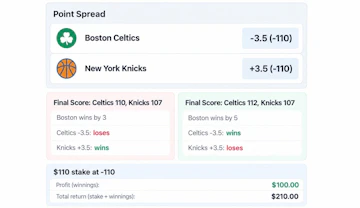
Half-point spreads such as -3.5 cannot produce a push because the final margin cannot land on half a point. With a whole-number spread such as -3, a three-point winning margin produces a push and the stake is returned.
Point spreads therefore separate the question of who wins the game from who covers the handicap.
Point Spread Quick Guide
- What you're predicting: Whether a team finishes on the winning side of the spread
- Selections: One
- Main feature: A handicap changes the result required for the bet to win
- When to use it: When you have a strong read on how competitive the matchup will be or by how much one side should win
Totals
A total, commonly called an over/under, is a wager on whether a specified statistic finishes above or below the sportsbook's line.
The standard game total uses the combined scoring of both teams. The bettor does not need to choose the winner.

The same over/under structure also appears in team totals and player props. What changes is the statistic being measured, not the basic mechanism of the wager.
Totals Quick Guide
- What you're predicting: Whether a scoring or statistical result finishes above or below a posted line
- Selections: One
- Main feature: The bet focuses on an amount rather than the winner
- When to use it: When you think the game will be high-scoring or low-scoring
Prop Bets
A proposition bet, usually shortened to prop, focuses on a specific event, statistic or performance rather than necessarily on the final winner.
The market defines one particular question. That could concern a player's points, a team's scoring output, which side reaches a milestone first or whether a certain event occurs during the game.
For example:
- Jalen Brunson Over 27.5 points (-115)
- Celtics team total Over 114.5 (-110)
- Celtics first team to 30 points (-125)
The exact wording of a prop is important because that wording defines the result being measured.
A player's points prop, first-basket prop and points-plus-assists prop can all feature the same player while representing completely different wagers.
Proposition Bet Quick Guide
- What you're predicting: A specific performance, statistic or event
- Selections: One when placed as a straight bet
- Main feature: The wager isolates one defined part of a larger event
- When to use it: When you want to bet the specific performance or game event - not the whole game
Player Props
A player prop is a proposition bet tied specifically to an individual player's performance.
Sportsbooks offer player props across many sports, including:
- Points
- Rebounds
- Assists
- Passing Yards
- Rushing Yards
- Strikeouts
- Shots
- Touchdowns
- Etc.
The player's performance settles the wager, regardless of what the final game result is.
For example:

Player props make the market much more granular. Instead of deciding what happens to an entire team, the bettor is isolating one component of one player's performance.
Player Prop Quick Guide
- What you're predicting: An individual player's performance
- Selections: One when placed as a straight bet
- Main feature: The wager is settled by a specific player statistic or event
- When to use it: When you trust your read on the player more than your read on the game
Game and Team Props
Game and team props focus on a specific event or team result without tying the wager to one individual player.
A team prop isolates something one team does. A game prop focuses on an event or condition within the game as a whole.
For example:

That market is settled as soon as one team reaches 30 points. The team that eventually wins the game is irrelevant to that wager.
Other game and team props can cover aspects like winning margin, first scoring team, overtime, team-specific totals and other clearly defined events.
Game and Team Props Quick Guide
- What you're predicting: A defined team-specific or game-specific event
- Selections: One when placed as a straight bet
- Main feature: The wager focuses on one component of the game rather than the final winner
- When to use it: When one specific thing in the game stands out more than the final score
Futures
A futures bet concerns an outcome decided later in a season, competition or tournament.
Common futures markets include:
- Championship Winner
- Conference or Division Winner
- Tournament Winner
- Season Win Total
- Major Individual Awards
The defining feature is the longer settlement horizon.
While a game wager is resolved from one event, a futures market can remain open across weeks or months while an entire competition develops.
For example:

Once the wager is accepted, your wager is locked at the price of +600.
The sportsbook will move the Dodgers price as the season develops and standings change, players get injured, etc. However, that will not alter the payout to your original wager.
Futures Quick Guide
- What you're predicting: A season, tournament, championship or award outcome
- Selections: One when placed as a straight bet
- Main feature: The wager remains open until a longer-term market is decided
- When to use it: When you have a season-long opinion you are willing to put money behind and wait out
Multi-Selection Bets
Multi-selection bets combine several predictions into a larger betting structure. Each individual selection inside the wager is called a leg.
Parlays, same-game parlays, teasers and round robins all involve multiple selections, but they combine those selections in different ways.
Parlays
A parlay combines two or more selections into one wager. Every active leg must win for the parlay to win - if one leg loses, the entire parlay loses.
Combining selections increases the number of conditions attached to one wager. That is why a multi-leg parlay can display a much larger potential return than any one of its individual bets.
The larger price reflects the fact that every required outcome must occur together.
For example:

If the Chiefs fail to cover -3.5, the parlay loses even if the Celtics and Dodgers both win.
When a leg pushes, is void or is declared no action, that leg drops out and the parlay is recalculated using the remaining active legs.
For example, a five-leg parlay with one voided leg will become a four-leg parlay.
Parlay Quick Guide
- What you're predicting: Several outcomes on one combined ticket
- Selections: Two or more
- Main feature: Every required active leg must win
- When to use it: When you want to combine several selections for longer odds and a larger potential payout
Same-Game Parlays
A same-game parlay, or SGP, combines multiple selections from the same sporting event. Like a standard parlay, every required active leg must win.
That creates an additional factor: correlation.
Correlation means that one result affects the likelihood of another result. Outcomes within the same game often influence one another because they develop from the same scoring, pace, game state and player performances.
For example:

The sportsbook models how each selection changes the probability of the others and adjusts the combined price accordingly.
The stronger the relationship between the legs, the more important that correlation adjustment becomes. In heavily correlated cases, the sportsbook can substantially reprice the combination or decline to offer it altogether.
Same-Game Parlay Quick Guide
- What you're predicting: Several outcomes within the same event
- Selections: Two or more
- Main feature: The legs can be correlated because they come from the same game
- When to use it: When one game gives you several angles you like and you want to combine them
Same-Game Parlay Plus (SGP+)
Same-Game Parlay Plus, or SGP+, extends the same-game parlay structure across more than one event.
Instead of building every leg from a single game, the bettor can combine a same-game parlay with selections or same-game combinations from additional events.
For example, an SGP+ ticket could contain:

The wager now depends on all of the required same-game outcomes plus the Chiefs spread.
The exact name of this wager varies across sportsbooks, but the underlying structure is straightforward: it takes the same-game parlay concept and extends the ticket beyond one event.
SGP+ Quick Guide
- What you're predicting: Multiple same-game outcomes plus selections from additional events
- Selections: Three or more
- Main feature: Extends an SGP beyond one sporting event
- When to use it: When you have a clear same-game angle and also want to add bets you like from other events
A teaser is a multi-selection wager that adjusts eligible point spreads or totals by a fixed number of points before combining them into one ticket.
The teaser does not simply improve an ordinary spread bet for free. You receive more favorable lines than the original market, but the sportsbook changes the price to account for that adjustment.
All adjusted selections must win for the teaser to win.
For example:

Teaser Quick Guide
- What you're predicting: Multiple spread or total outcomes with adjusted lines
- Selections: Two or more
- Main feature: Eligible lines move in the bettor's favor before the selections are combined
- When to use it: When a few extra points materially improve multiple spread or total bets you already like.
Round Robins
A round robin takes a group of selections and automatically divides them into multiple smaller parlays.
Unlike a standard parlay, the entire group does not live or die as one ticket. Each smaller parlay is a separate wager and settles independently.
When making a Round Robin, you will choose both the selections and the combination size.
For example, a round robin by 2s using three selections creates every possible two-leg parlay from those three picks:

If one selection above loses, the combinations containing that selection lose. However, a combination made entirely from winning selections can still cash.
The number of wagers increases quickly as more selections are added. A four-selection round robin by 2s creates six separate parlays. Five selections by 2s create ten.
The combination count is one of the most important numbers on a round-robin bet slip because it determines how many wagers are actually being placed.
Round Robin Quick Guide
- What you're predicting: A group of selections distributed across several smaller parlays
- Selections: Multiple
- Main feature: Each generated parlay is a separate wager
- When to use it: When you want several selections split into smaller combinations instead of making every pick dependent on one full parlay
Live Betting
Live betting, also called in-play betting, is when you place a wager on a sporting event after it has already started.
Live betting does not create an entirely separate family of underlying predictions: Moneylines, point spreads, totals and props are all offered after play begins.
The difference is that the live market incorporates information that has already developed during the event: the score, time remaining, player performance, game state and other relevant information.
That makes live prices and lines dynamic. A pregame market reflects what is known before the event starts. A live market reflects what has happened since.
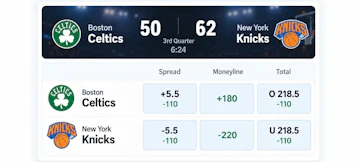
Live markets update as the event changes and temporarily suspend while the sportsbook processes significant game events.
Live Betting Quick Guide
- What you're predicting: A result based on the current state of an event already in progress
- Selections: One or more depending on the underlying wager
- Main feature: The line or price reflects information from the event as it happens
- When to use it: When you want to get a sense of the game conditions before you bet
Choosing the Right Bet Type
Choosing the right bet type is part of handicapping the wager. The same opinion about a game can often be expressed through several different markets, but those markets do not ask the same question or carry the same price.
The goal is to use the wager structure that best matches what you actually believe will happen, while understanding exactly what you are paying for that exposure.
A bettor does not need to have an opinion on every part of a matchup.
If you strongly believe a team wins but have little confidence in the margin, the moneyline expresses that view more directly than the spread. If your analysis is mostly about pace and scoring, the total may be the better fit. If your edge comes from a player's role, minutes, matchup or usage, a player prop can isolate that opinion without forcing you to take a position on the entire game.
The sharper the betting thesis, the easier it becomes to choose the market that actually reflects it.
Picking the right outcome is only half the decision. The odds determine what you are being asked to risk for that prediction.
Two markets can express similar views while offering very different prices. A favorite may look more attractive on the moneyline than against an inflated spread. A player prop may move from -110 to -135 without the underlying prediction changing at all. Parlays and SGPs bundle several prices into one combined number, which can make the cost of the wager less obvious.
Experienced bettors evaluate the market and the price together. The question is never simply whether an outcome can happen, but whether the offered odds make sense for the probability you are assigning to it.
More complicated wager structures add more conditions that have to be satisfied.
A parlay adds additional legs. An SGP adds both extra legs and correlation. A teaser improves the individual lines but gives something back through the price. A round robin turns one group of selections into several separate wagers.
That complexity can be useful when it reflects the actual betting thesis. It becomes much harder to justify when extra legs are being added mainly to make the potential payout look bigger.
A good rule is simple: every additional condition on the ticket should have a clear reason for being there.
Bet type also changes how long the wager remains unresolved and how much can happen before settlement.
A game-day straight bet can settle within hours. A future can remain open for months while injuries, standings, roster changes and schedule developments reshape the market. Live bets introduce the opposite problem: the information changes quickly, and the sportsbook reprices the market almost immediately.
The longer or more complicated the path to settlement, the more variables the bettor is accepting along with the original prediction.
Questions to Ask Before Choosing a Bet Type
Before placing a wager, the useful questions are straightforward:
- What exactly is my betting thesis?
- Which market expresses that view most directly?
- Am I comfortable with the price being offered?
- Does every extra leg or condition have a real purpose?
- Are any selections correlated or dependent on the same game script?
- How long will the wager remain open before it can settle?
- Am I choosing this structure because it fits the bet, or because the potential return looks attractive?
If you can answer those questions clearly, you should also be able to explain exactly why that bet type fits your view. If you cannot, the structure probably needs another look.

JD has been betting since 2009, back when his bookie was a guy named Vin who ran lines out of Philly. He survived the sketchy offshore days (barely) and made the jump to regulated sportsbooks the second New Jersey legalized in 2018. Since then, he’s turned hunting bonuses and exploiting odds boosts into an art form.
These days, JD specializes in helping new bettors skip the rookie mistakes, as well as showing seasoned ones how to play the promo game like a pro. If there’s a bonus to be had or a line that doesn’t look right, JD’s probably already on it.


