
Prediction Markets 101
How to Buy & Sell Prediction Market Contracts - Order Types Explained
Learn how buy and sell orders work, how order types behave, and how to avoid common execution mistakes when trading prediction markets.
This guide is for educational purposes, not legal advice. U.S. rules and enforcement positions can evolve, and availability may vary by state.
Before trading, you should review the rules that apply in your jurisdiction and confirm that any platform you use is authorized to operate in the United States.
This guide will explain:
- What a buy order does when you enter a prediction market position
- How orders are filled, and why the price you see is not always the price you get
- The main order types used on prediction markets, including when to use each one
- How selling a contract before settlement works, and why it is usually closing a position rather than taking the opposite side
- The most common order mistakes beginners make, and how to avoid them
If prediction markets feel unfamiliar to most bettors at first, it’s usually not because the concept of speculating on real-world outcomes is new or hard to understand. The difference is in how you enter a trade.
Instead of simply picking a side and placing a bet, you’re choosing how to enter - what price you’re willing to accept, whether you want instant execution, or more control over the trade.
On regulated platforms, every trade is matched between buyers and sellers. You’re placing an order, and the platform fills it when someone on the other side agrees on price. That exchange-style mechanic sits behind every buy and sell button you see.
Buying a Prediction Market Contract
Buying a prediction market contract is the point where the idea becomes a trade.
Once you decide you want exposure to an outcome, the next step is not just choosing Yes or No.
You also need to understand how your order enters the market, what price you are actually trading at, and why the contract may not fill exactly the way you expect.
What Happens When You Place a Buy Order
A buy order is your instruction to purchase contracts on one side of a market, usually Yes or No.
If you buy Yes, for example, you are paying a current market price for a contract that will later settle at $1 if the outcome happens or $0 if it does not. That fixed settlement structure is what makes entry price so important. Your upside and downside both start with what you paid.
Before you buy, treat the contract specs as part of the trade. The exact wording, end time, and resolution source decide what the market is actually asking and how it will settle. A lot of beginner mistakes are not about calling the event wrong. They are about buying a contract they did not read carefully enough.
How Orders Get Filled on a Prediction Market
Prediction markets use an exchange model. Traders submit orders, the platform runs the market, and trades happen when both sides agree on price.
In practical terms, if you buy immediately, you usually trade against the best ask. If you sell immediately, you usually trade against the best bid.
That is why the headline market price is not always the exact price you get. Some screens show the last traded price or a midpoint, while your actual execution depends on the orders available when you click.
That is also where spread and liquidity come in - a tight spread usually means cleaner execution.
A wide spread means you may pay more to get in or give up more to get out. In thinner markets, part of your order may fill and the rest may stay open. That is called a partial fill. If nothing matches your price, the order stays unfilled.
Before you place a buy order
- Check the contract wording and settlement rule
- Look at the best available price, not just the headline price
- Notice whether the spread is tight or wide
- Start smaller in thin markets
- If part of the order does not fill, review the remaining live order before leaving it open
Prediction Market Order Types Explained
Order types control how your trade is executed. Some are built for speed, while others are built for price control. Understanding the difference matters because the same market view can produce very different results depending on how you enter and exit the trade.
Market Orders
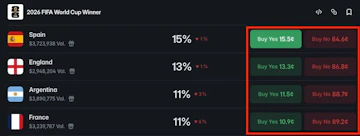
Market Orders - also called Quick Orders in some platforms - tell the platform to fill your trade immediately at the best available price.
It is designed for speed, not price control, so it works best when the market is liquid and the spread is tight.
You get into or out of the market fast, without having to choose a price yourself - but speed comes with a tradeoff. If there is not much liquidity available at the best price, parts of your order can fill at worse prices further down the book.
When to Use Market Orders

Use a market order when you care more about getting the trade done now than about shaving a cent or two off the price. That usually makes the most sense in an active market where there is a lot of liquidity near the best price, the spread is tight, and the market moves quickly.
It is usually a worse fit when the market is thin, the spread is wide, or you are trading larger size.
Fills immediately if there is available liquidity
Simple for beginners to understand
Useful when the market is moving and speed matters
Reduces the chance of missing the trade entirely
You do not control the exact price
Can fill at multiple price levels
Can be expensive in thin markets
Easy to overpay if you trade without checking the spread first
Market Order Example
Suppose you are trading Kalshi’s “Presidential Election winner?” market, a long-dated market currently listed under Kalshi Elections.
You want exposure to Gavin Newsom right away because you think his current price will move higher after upcoming campaign developments.
If you place a market order, Kalshi will fill the trade immediately at the best available prices in the book. However, if there is not enough size at the top price, part of your order may fill higher than you expected.
Limit Orders
A limit order lets you set the maximum price you are willing to pay when buying - or the minimum price you are willing to accept when selling.
The platform will only execute your order at that price or better. Limit orders gives you exact price control, at the cost of speed.
When to Use Limit Orders
Use a limit order when price matters more than speed.
This is often the better default for beginners, especially in slower markets or when you already know the number at which the trade makes sense to you.
If the market never reaches your price, the order may sit there unfilled.
Gives you full price control
Helps avoid paying more than planned
Better for wide spreads or thinner markets
Encourages more disciplined entry and exit decisions
Order may fill partially - or not at all
Can leave you waiting while the market moves away
You need to remember the order may still be live
Limit Orders Example
You are looking to trade on the "How high will unemployment get before 2030?” market, which is a long-dated macro market. '
Say you want to buy the “Above 9%” contract, but only if the price falls to a level you think offers value. Instead of buying immediately, you place a limit order at your chosen price and wait.
If the market comes down to that level, your order fills. If it does not, you stay out of the trade rather than paying more than you wanted.
Other Order Types
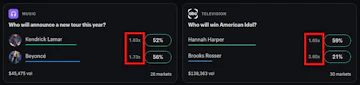
Some platforms add extra instructions on top of the basic order. You may see things like a time setting that keeps the order live until canceled, or an order that expires at the end of the day.
These are not new "bet types". They are instructions about when or how your buy or sell should remain active.
If your platform offers them, read the order ticket carefully before using them to ensure you know exactly how they will behave.
GTC (Good-Til-Cancelled) leaves a limit order open until it fills or you cancel it.
This is useful if you are willing to wait for the market to come to your price, but the risk is forgetting the order is still live.
GTD (Good-Til-Date) works the same way, except the order expires automatically at a time you choose.
This is useful if you only want the order active before a specific event or deadline.
FOK (Fill-Or-Kill) tells the platform to fill the entire order immediately or cancel it completely.
This is mainly useful when you need the full size and do not want a partial fill.
FAK (Fill-And-Kill) fills whatever is available immediately and cancels the rest.
This can be useful if you want instant exposure but do not want any unfilled portion left sitting on the book.
Selling a Prediction Market Contract Before Settlement
You do not need to hold a prediction market contract until the event resolves. If the market is still open and there is enough liquidity, you can sell your position early at the current market price.
For many traders, this is a core part of how prediction markets work in practice. You might exit because the price has moved in your favor, because your view has changed, or because you want to reduce risk before new information hits the market.
Why Traders Sell Before Settlement
Selling before settlement gives you flexibility. Instead of waiting for the final outcome, you can react to price movement while the market is still open. That matters because prediction markets are not just about being right at the end. They are also about managing position size, timing, risk, and capital while the market is live.
Lets take a look at some of the reasons why you might want to sell contracts before resolution:
- To lock in profit - If the contract price has moved in your favor, selling lets you realize that gain instead of leaving it exposed to later market moves.
- To cut risk - If the market is moving against you, selling early can limit further losses rather than waiting for a full win-or-lose settlement.
- To reduce exposure before uncertainty - Traders often sell before debates, earnings releases, court rulings, economic data, or election nights if they do not want to sit through a volatile event.
- To free up capital - Money tied up in one position cannot be used elsewhere. Selling early lets you move capital into a better setup.
- Because your view has changed - New information may make the original trade less attractive. Selling is often the cleanest way to act on an updated view.
- To manage position size - A trader may want to trim part of a winning or losing position without fully exiting.
- To avoid late-stage liquidity or event risk - In some markets, the final stretch can become more volatile or less comfortable to hold through. Selling early can reduce that stress.
How a Sell Order Works
A sell order is your instruction to exit some or all of your position at the best available market price or at a price you choose. Mechanically, it works the same way as a buy order, just from the other side of the market:
- If you use a market order, you are telling the platform to sell immediately into the best available bids.
- If you use a limit order, you are setting the lowest price you are willing to accept and waiting for a buyer to meet you there.
Just like with buying contracts, the price shown on the screen is not always the exact price you will receive. What you can actually sell for depends on the best bid, the depth of buyers behind it, and how much size you are trying to unload.
If you are selling a small position in a liquid market, execution may be smooth. If you are selling a larger position in a thin market, you may only get part of the order filled at the top price and the rest at worse prices, or not filled at all.
This is why selling should not be treated like a sportsbook cash-out button: In a sportsbook, cash-out is an offer generated by the house. In a prediction market, your exit depends on real market liquidity and matching.
You are trading with the market, not accepting a house offer.
Before you place a Sell Order
A good selling process usually looks like this:
- Check the current bid, not just the headline market price
- Look at the spread to see how costly an immediate exit may be
- Decide whether speed or price control matters more
- Use a market order only when you are comfortable accepting the best available bid
- Use a limit order when you want to avoid selling below a certain price
- Review the fill to make sure no remaining portion of the order is still live unless that is your intention
A sell order is not just an “exit” button, it is a trade with its own execution risk. The same discipline you use when entering a position should also be used when closing one.
Selling to Exit vs. Selling to Take the Other Side
This is one of the easiest places for beginners to get confused.
Most of the time, when a trader sells a contract before settlement, they are closing an existing position. They already own the contract, and selling reduces or removes that exposure. If you bought Yes at 42 cents and later sell that same Yes contract at 58 cents, you have exited the trade and realized your gain. That is a normal position close.
Short selling - aka taking the other side - is different. That means opening a new position that benefits from the opposite outcome. One action is about getting out. The other is about putting on fresh exposure.
That difference matters for three reasons:
- The purpose is different - Exiting is risk reduction. Taking the other side is a new directional trade.
- The capital decision is different - Closing a position frees capital. Opening the opposite side commits capital to a new view.
- The mental process should be different - A good trader should not reverse a position by accident just because the buttons look similar on the interface.
A simple way to think about it is this:
If your goal is to stop being exposed to the trade, you are trying to exit.
If your goal is to express a new opinion about the market, you are trying to take the other side.
That distinction helps beginners stay more deliberate. It reduces the risk of turning a simple exit into an unintended second trade.
Common Order Mistakes Beginners Make
Most beginner mistakes in prediction markets are not dramatic. They are small execution errors that quietly make the trade worse.
The good news is that they are also highly avoidable once you know what to look for. A few simple habits around order choice, pricing, and position management can prevent a lot of unnecessary damage.
A market order can sweep through several price levels and give you a much worse fill than expected.
Do instead: Check the spread and available depth first. If liquidity looks thin, use a limit order.
Beginners often look only at the headline price and miss the real cost of entering or exiting immediately.
Do instead: Look at both the bid and ask before placing the trade so you understand the actual executable prices.
New users sometimes expect instant, house-style pricing and do not account for order matching, liquidity, or partial fills.
Do instead: Think of the platform as a market with buyers and sellers, not a bookmaker offering a fixed quote.
An order that does not fill immediately may still be live and could execute later when your view has changed.
Do instead: Review all open orders after placing them and cancel anything you no longer want active.
Some traders think every sell action means they are betting against the outcome, when they may just be closing an existing position.
Do instead: Always ask whether you are reducing exposure or opening a new view before you click.
A trader can have the right market view and still get poor results from bad entry and exit prices.
Do instead: Treat execution as part of the edge. Price discipline matters just as much as the prediction.
Even a good idea can become a bad trade if your order is too big for available liquidity.
Do instead: Start smaller, especially in thinner markets, and scale only if the book can handle it cleanly.
Orders like GTC, GTD, FOK, and FAK can be useful, but they can also create confusion if the trader does not understand how they behave.
Do instead: Learn market and limit orders first, then use advanced instructions only when you understand the exact purpose.

Ari started his gaming career as a poker grinder, then a crypto trader, before stumbling onto prediction markets. He’s now deep into betting on everything from politics to pop culture to tech layoffs. If it has uncertainty and odds, Ari’s in.
Skeptical by nature, Ari is fully convinced that the weirdest bets often hide the sharpest edges. If you’ve ever wondered whether it’s possible to beat the market by reading the news better than everyone else - Ari’s here to show you how.


