
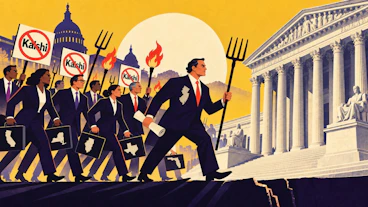
39 States Join New Jersey in Supreme Court Fight Over Kalshi Sports Markets

Key Points
- The coalition's filing joins briefs from gaming regulators, tribal interests and anti-gambling groups seeking nationwide clarity.
- The filing comes after federal appeals courts reached conflicting conclusions over whether state gambling laws can apply to sports prediction markets.
- The states argue Kalshi’s federal preemption theory threatens state licensing, age restrictions, exclusion programs and other gambling protections.
- The Supreme Court has yet to decide whether to hear the case, and Kalshi’s response is now due November 9.
39 States Back New Jersey’s Supreme Court Challenge to Kalshi
Attorneys general from 39 states and Washington, D.C. submitted an amicus brief to the Supreme Court Wednesday supporting New Jersey’s petition in Flaherty v. KalshiEX.
The filing asks the justices to resolve whether federal commodities law prevents states from applying their gambling laws to sports event contracts offered through CFTC-regulated exchanges.
The states contend that Kalshi’s interpretation of the Commodity Exchange Act would displace powers that states have traditionally exercised over gambling. Their brief specifically points to licensing systems, exclusion lists, minimum-age requirements and spending limits among the protections that could be affected if federal law is found to preempt state gambling regulation.
The coalition argues that the litigation has moved well beyond an isolated dispute between one operator and one regulator. Its brief describes the appellate landscape as “a direct, but messy, split” and says states are now in a “regulatory turf war with the CFTC.”
Federal appeals courts now disagree on the core legal questions
The dispute centers on two related questions: whether Kalshi’s sports event contracts qualify as “swaps” under the Commodity Exchange Act, and whether the CFTC’s exclusive jurisdiction over covered transactions prevents states from enforcing their gambling laws against those contracts.
The Third Circuit gave Kalshi the favorable appellate ruling that New Jersey is now challenging.
In its April opinion, the court held at the preliminary injunction stage that Kalshi had shown a reasonable likelihood of success on its argument that the Commodity Exchange Act preempts New Jersey gambling laws as applied to sports event contracts traded on its designated contract market. The majority treated those contracts as swaps falling within the federal regulatory framework.
The Ninth Circuit reached the opposite result in August. Its unanimous panel concluded that Kalshi’s sports event contracts were not swaps under the statute and therefore were not protected from state gambling regulation by the CFTC’s exclusive-jurisdiction provision.
The Sixth Circuit deepened the split on September 25. It also concluded that Kalshi had not shown its sports contracts qualified as swaps, but went further by holding that the Commodity Exchange Act’s exclusive-jurisdiction language did not expressly or impliedly preempt the state gambling laws before the court.
That leaves three federal appellate courts with different reasoning and, more importantly, different regulatory outcomes.
Regulators, tribes and gambling groups are also asking the Court to intervene
The state coalition is one of several groups urging the Supreme Court to take the case. The official Supreme Court docket shows briefs from the National Council of Legislators from Gaming States, the International Association of Gaming Regulators and North American Gaming Regulators Association, the Cabazon Band of Cahuilla Indians, and a group including Stop Predatory Gambling and Texans Against Gambling.
Those filings approach the dispute from different institutional interests, but collectively add pressure for a national answer. The state attorneys general are focused heavily on sovereignty and consumer regulation, while gaming regulators and tribal interests have their own reasons for opposing a legal framework that could place sports contracts outside established state and tribal gambling systems.
The Supreme Court has not yet decided whether to review New Jersey’s petition. Kalshi originally faced an October 8 response deadline, but the Court granted an extension through November 9.
Why This Matters For Bettors

For bettors, the most immediate consequence of this legal fight is market access. Kalshi offers contracts on the same games listed by state-regulated sportsbooks, but under a different regulatory framework. Which rules apply can determine where customers are allowed to trade, what age restrictions they face and which protections are available when something goes wrong.
Kalshi's April victory in the Third Circuit strengthened its argument that federal law overrides state gambling restrictions. Then the Ninth Circuit rejected that position in August, followed by another state-friendly ruling in September.
These decisions carry different legal weight across jurisdictions, leaving Kalshi's position stronger in some regions than others. Ohio's recent enforcement action against 10 companies shows how quickly those rulings can influence what platforms offer bettors.
There is also a consumer protection issue that deserves more attention than it typically receives. State-licensed sportsbooks operate under rules governing age eligibility, self-exclusion, responsible gambling controls and regulatory oversight of customer complaints. Federally regulated exchanges have their own compliance obligations, but those requirements were developed for financial markets. The states are concerned that allowing sports contracts to bypass gambling regulation would leave customers without protections specifically designed for sports wagering.
A Supreme Court ruling favoring Kalshi would give federally regulated exchanges a stronger foundation for offering sports markets nationally, potentially putting licensed sportsbooks at a competitive disadvantage over compliance costs. A ruling favoring the states could force exchanges to restrict access, pursue different licensing arrangements or reconsider their sports offerings.
The involvement of 39 states is particularly significant because it demonstrates how far the regulatory conflict has spread. State officials are effectively telling the justices that inconsistent federal rulings are making gambling laws increasingly difficult to enforce.
While their numbers do not determine the legal merits, they do strengthen the case for Supreme Court intervention before the regulatory divide grows wider.
What Happens Next
Kalshi’s response is due November 9. After that filing, the petition can move toward consideration by the justices, who can grant review, deny the petition or take another procedural step before deciding whether to hear the case.
Until the Supreme Court acts, the circuit split remains. Courts and regulators will continue operating under the appellate precedent that applies in their jurisdictions, while Kalshi and other prediction market companies face an increasingly fragmented legal landscape.
Marcus has spent over 20 years navigating the legal side of online betting - from his early days consulting for offshore operators to helping licensed U.S. sportsbooks launch in regulated markets. He’s worked with compliance teams, reviewed licensing frameworks in 15+ states, and advised on some of the biggest regulatory shifts since PASPA was repealed.
At BettingScanner, Marcus serves as the voice of reason - translating legalese into plain English and helping bettors understand what’s legal, what’s risky, and where the gray areas live. If you’re ever unsure about the rules, Marcus is your man - as he probably helped write them.


