
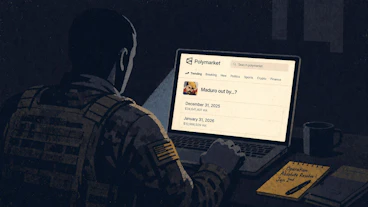
U.S. Soldier Charged After Allegedly Using Classified Intel to Win $400K on Polymarket

Key Facts
- Federal officials charged Army master sergeant Gannon Ken Van Dyke with multiple crimes after alleging he used classified information about the Maduro operation to place Polymarket trades.
- Prosecutors say the bets generated more than $404,000 in profit, with another roughly $5,000 coming from three other Venezuela-related contracts.
- The CFTC filed a parallel civil complaint, while Polymarket said it alerted the Justice Department and cooperated with the investigation.
- The case is the first U.S. criminal prosecution directly tied to alleged insider trading on a prediction market.
Prosecutors Say the Trades Were Timed to a Secret Maduro Operation
Federal prosecutors announced Thursday that Gannon Ken Van Dyke, a 38-year-old Army special forces soldier stationed at Fort Bragg in North Carolina, was charged with unlawfully using confidential government information for personal gain, theft of nonpublic government information, commodities fraud, wire fraud, and making an unlawful monetary transaction.
According to the AP’s report on the filing, prosecutors say Van Dyke used classified information tied to the January operation to capture Venezuelan president Nicolás Maduro to place a series of well-timed Polymarket bets.
Polymarket said it identified suspicious trading tied to classified government information, notified the Justice Department, and cooperated with the investigation, claiming in a statement:
Insider trading has no place on Polymarket. Today’s arrest is proof the system works.
What the prosecutors allege Van Dyke did
According to the complaint, Van Dyke was involved in the planning and execution of the Maduro operation beginning on December 8, 2025.
Prosecutors say that despite signing nondisclosure agreements, he moved $35,000 into a crypto exchange account on December 26 and then used more than $32,500 to place bets on Maduro being out of power by January 31, 2026.
Most of those trades were allegedly placed on January 2, just hours before the operation began.
The CFTC’s parallel complaint, says those trades returned more than $404,000 in profits. Three additional Venezuela-related contracts allegedly produced more than $5,000 more.
After the operation, officials say Van Dyke moved most of the winnings into a foreign crypto vault and then into a new brokerage account, and also asked Polymarket to delete his account after claiming he had lost access to the associated email.
The arrest drew responses from regulators - and Trump
Federal regulators moved in parallel with the criminal case. The CFTC said it filed a civil complaint against Gannon Ken Van Dyke the same day the indictment was unsealed, seeking restitution, disgorgement, civil penalties, trading and registration bans, and a permanent injunction.
The agency also said this is the first time it has charged insider trading involving event contracts, and the first time it has used the so-called “Eddie Murphy Rule” in a case involving misuse of government information.
The case also reached the White House. Asked about Van Dyke’s arrest in the Oval Office on Thursday evening, President Donald Trump said he would look into it and compared the allegation to Pete Rose betting on his own team.
When asked separately about betting markets tied to Iran, Trump said, “The whole world unfortunately has become somewhat of a casino,” adding that he does not like the concept.
Why This Matters For Bettors

For bettors, this is bigger than one ugly headline. It is the first real proof point that prosecutors are willing to treat alleged abuse on prediction markets the way they would treat other forms of fraud tied to privileged information.
There is a user-confidence angle here that matters just as much as the legal one. Prediction markets sell themselves as information-rich products. That is part of the appeal. But the same thing that makes them compelling also makes them vulnerable.
When the edge comes from better analysis, sharper reading, or faster interpretation of public information, that is the game. When the edge comes from classified operational knowledge, the product starts to look a lot less like a market and a lot more like a leak with a price attached.
That is an inference based on the charges and the platform’s own response, but it is the obvious trust problem this case brings into focus.
There is also a positive read for the industry, and it should not be ignored. Polymarket did not wave this away as “market activity” or hide behind decentralization language. It referred the matter to DOJ and cooperated. That is exactly what a serious platform is supposed to do when it believes someone is trading on information the broader market could never fairly access. If prediction markets want to be treated as legitimate venues rather than novelty bets in a crypto wrapper, this is the kind of response they need to show.
The harder question is whether insider trading can really be curbed in this category. It can probably be reduced more than eliminated. Markets on elections, wars, ceasefires, raids, and policy outcomes are naturally attractive to people sitting unusually close to the facts.
That is not a flaw unique to prediction markets, but it is a sharper risk for them because the whole product is built around converting information into tradable prices. The result is that every major enforcement case doubles as a stress test for the category itself.
What Happens Next
The immediate next step is legal. Van Dyke now faces criminal charges from DOJ and a civil action from the CFTC, which means the facts behind the trades will be tested in both criminal and regulatory channels.
For the market, the next question is whether this case becomes a one-off cautionary tale or the start of a more aggressive enforcement phase.
Bipartisan lawmakers are already considering legislation that would block prediction markets from offering contracts tied to war, assassinations, or terrorist attacks. The White House has also warned staff against using private information to trade on prediction markets after other suspicious geopolitical trades drew attention earlier this month.
For bettors, the practical takeaway is not that prediction markets are broken. It is that they are maturing into a space where surveillance, referrals, and criminal exposure are becoming part of the landscape.
In a strange way, that is both the bad news and the good news. The bad news is that the insider-trading risk is real. The good news is that platforms and the government are taking severe actions against it.
Cole cut his teeth as a sportswriter in Texas, covering everything from Longhorns games to small-town Friday night lights. A lifelong bettor stuck with offshore books for over a decade thanks to Texas' slow path to legalization, he eventually found his way into the world of social sportsbooks - where he uncovered a fast-growing, community of bettors.
Today, he writes for the millions of Americans in states without legal books, helping them explore safe ways to bet without running afoul of the law.
As editor-in-chief, he aims to keep BettingScanner honest, human, and grounded in what bettors actually care about: fairness, fun, and finding your lane - even when the state won’t give you one.


