
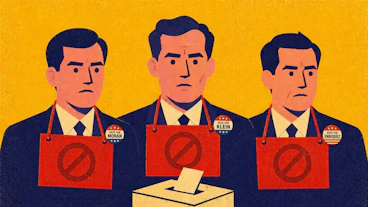
Kalshi Suspended Three Candidates for Insider Trading on Their Own Elections

Key Facts
- Mark Moran, Matt Klein, and Ezekiel Enriquez traded on their own election outcomes and were each suspended from the platform for five years.
- Moran, an independent Senate candidate in Virginia, drew the largest penalty at more than $6,200 after refusing to settle; Klein and Enriquez settled for roughly $540 and $780.
- Kalshi had announced new guardrails in March, including tools meant to preemptively block political candidates from trading on their own campaigns.
- The case lands as event contracts face bipartisan scrutiny in Washington and broader questions about whether market operators can stop insider trading before regulators force stricter rules.
Kalshi’s Own Enforcement Test Just Arrived
Kalshi said Wednesday that three candidates traded on the outcomes of their own races and were punished under the platform’s insider-trading rules:
- Mark Moran, an independent U.S. Senate candidate in Virginia
- Ezekiel Enriquez, a Republican House primary candidate in Texas
- Matt Klein, a Democratic Minnesota state senator running for Congress in Minnesota
All three were suspended for five years. Moran was fined more than $6,200 after refusing to reach a settlement, while Klein and Enriquez settled and were fined just over $530 and $780, respectively.
The actual trades placed by the candidates were small - Klein and Enriquez each placed bets of less than $100, while Moran said on social media that he “traded $100 on (him)self.”
That is exactly why the case matters. This was not a balance-sheet event for Kalshi - it was a credibility event. If candidates themselves are willing to test whether they can trade on their own races, critics get an easy line of attack: these markets do not just carry insider-trading risk, they attract it.
Kalshi had already said this conduct was banned
This is not a case where the platform had no rule and had to improvise one after the fact.
Kalshi announced new insider trading guardrails on March 23, saying it was expanding its anti-manipulation capabilities and launching tools to “preemptively block politicians” from trading in certain politics markets.
Kalshi noted that - while its policies had always prohibited candidates from trading on their own campaigns - these measures were designed to address recent CFTC guidance and proposed congressional legislation around insider trading and market manipulation.
What the candidates said
Moran did not deny making the trades. According to AP, he said he placed the bets to draw attention to what he described as the unjust sway platforms like Kalshi have on elections, and said he was fined more heavily because he refused to sign a settlement that would have required him to post a statement on X. He told AP:
When I piss people off, when I upset people, and when I captivate their attention, that’s when they have to start listening.
Klein publicly acknowledged his trade. In a statement he said the October 2025 transaction was the first and only trade he had ever placed on a prediction market and that he was “curious about how it worked.” He added: “This was a mistake, and I apologize.” Klein also said the episode pointed to “the need for clearer rules and regulations for these types of markets.”
Why This Matters For Bettors

For bettors, this is about confidence erosion before it is about scandal. The core pitch behind prediction markets is that price reflects information. That pitch falls apart fast when traders suspect some participants are not merely better informed, but are personally involved in the outcome being traded.
In a traditional sportsbooks context, bettors understand that athletes, coaches, referees, and insiders are supposed to be nowhere near the market. Prediction markets have been trying to prove they can enforce the same basic norm across politics and other event categories. When candidates trade on themselves, even for small amounts, the takeaway for regular users is not “the exposure was limited.” It is “who else is in this market that should not be?” That is an inference, but it is the logical trust question created by Kalshi’s own market-integrity framing.
The more interesting point is that Kalshi did the thing critics said it needed to do. It investigated, named the offenders, imposed fines, and issued five-year suspensions. That matters. A neutral exchange that wants to host controversial event contracts cannot hide behind neutrality once obvious conflicts appear on-platform. It has to surveil, judge, and remove bad actors. Kalshi is now doing that explicitly, which may undercut any clean “we’re just the venue” posture, but it is also the only serious way to defend the venue.
That does not mean insider trading can be fully solved. It probably cannot. Kalshi itself effectively acknowledged as much when it said “no screening system is perfect” and that motivated bad actors will keep trying to find ways around controls. That is the more honest read of this story. The realistic standard is not zero abuse. It is whether the platform can detect abuse, punish it consistently, and make the expected cost of cheating high enough that bettors still trust the market.
There is also a regulatory risk here that bettors should not ignore. The case arrives amid bipartisan scrutiny of prediction markets, and the CFTC in February pointed to prior Kalshi enforcement cases involving misuse of nonpublic information as it issued an advisory on event contracts.
Once lawmakers and regulators can point to candidates literally betting on their own races, the industry hands critics a cleaner factual argument for tighter restrictions. Even if the direct impact on everyday users is limited right now, the long-term effect could be narrower product menus, tougher onboarding, or greater limits on politically sensitive markets.
What Happens Next
The next step is whether enforcement scales.
Kalshi can point to this case as evidence that it is policing its own platform the way it said it would. That is useful for the company as it tries to defend political and event-based markets against critics who argue the category is structurally vulnerable to manipulation.
Politically, the case is likely to be cited by people who already want stronger federal rules around event contracts. Rep. Mike Levin dismissed the penalties as “a parking ticket,” which is the kind of line that can keep a small-dollar case alive in Washington long after the trades themselves stop mattering.
Catching a candidate who trades on his own race is the obvious test case. The tougher problem is detecting edge cases involving staff, consultants, campaign operatives, contractors, family members, or other people with real informational advantages but weaker public footprints.
Related News


Ari started his gaming career as a poker grinder, then a crypto trader, before stumbling onto prediction markets. He’s now deep into betting on everything from politics to pop culture to tech layoffs. If it has uncertainty and odds, Ari’s in.
Skeptical by nature, Ari is fully convinced that the weirdest bets often hide the sharpest edges. If you’ve ever wondered whether it’s possible to beat the market by reading the news better than everyone else - Ari’s here to show you how.


