
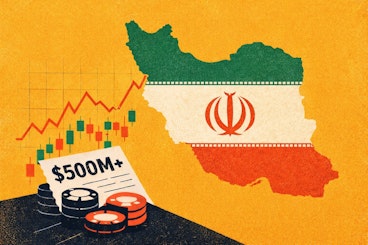
Prediction Markets Saw Over $500M in Iran-Strike Trading - and Face Insider Trading Scrutiny

Key Facts
- A Polymarket “U.S. strikes Iran” market drew more than $529 million in trading volume, per a roundup of market data and contract activity.
- Analytics cited by multiple outlets flagged newly created or newly funded wallets that profited heavily by betting on the strike timing, raising insider-trading concerns.
- Lawmakers are already using “war and armed conflict” contracts as evidence in a broader push to constrain prediction markets’ expansion in the U.S.
The Iran-strike contracts that turned into a liquidity event
The immediate catalyst was the Feb. 28 escalation involving U.S. and Israeli strikes on Iran, which rapidly pushed traffic and capital into a cluster of geopolitics markets. In the hours around the strikes and immediate aftermath, traders piled into markets designed to answer variations of two questions: whether more strikes were coming and when, and how far the conflict might escalate.
The biggest headline number came from Polymarket: a “U.S. strikes Iran” contract exceeded $529 million in trading volume, with one day’s activity (Feb. 28) listed at over $89 million, marking a step-change moment for geopolitics trading on prediction markets.
Polymarket’s own market pages show just how deep the engagement became. A “US next strikes Iran on…?” market displayed $55.1 million in total volume and detailed resolution rules that rely on “a consensus of credible reporting” and a 48-hour verification window — an example of how quickly trading on headlines can become trading on adjudication.
Insider allegations around this event are hard to ignore - and harder to prove
The insider-trading claims emerged because a small set of Polymarket accounts appeared to make highly specific, high-stakes bets on the timing of U.S. strikes on Iran - shortly before strikes were reported - and then profit immediately after the news hit.
The core allegation is not that someone predicted escalation - plenty of traders and analysts expected further strikes - but that certain accounts appeared unusually well-timed and unusually concentrated. Reporting tied to analytics work described clusters of wallets that were recently created or recently funded, placed large “Yes” positions on strike-by-a-date markets shortly before reported explosions, and then collected over $1.2 million in profits betting on the timing of strikes.
Why this becomes a regulatory issue even without definitive proof
None of that is, by itself, proof of illegal insider trading. In liquid markets, it is always possible that a concentrated bet is simply a high-conviction view. What makes this different is the combination of timing, wallet-funding behavior, and the real-world nature of the underlying event - where material nonpublic information can plausibly exist.
That pattern is enough to trigger a political and regulatory response even without a definitive evidentiary chain. In traditional financial markets, proving insider trading generally requires showing the trader possessed material nonpublic information and breached a duty - or knew it was misappropriated.
Even when enforcement is difficult - pseudonymous wallets, cross-border participation, and fragmented information sources - the trust problem is immediate. Kalshi has treated insider-style conduct as an existential issue for prediction markets, with its head of enforcement warning that if users don’t trust the markets, “they’re not going to use them.”
Why This Matters For Bettors

Most sports bettors are not trading geopolitics contracts. But the issue here is downstream: regulatory risk tends to spill over.
If lawmakers and regulators view high-profile war-related markets as evidence that prediction platforms can’t police insider-style information, ambiguous settlement standards, or ethically sensitive contracts, the response will not stay neatly confined to “geopolitics.” It can reach:
- which products are permitted in the U.S
- how aggressively platforms can market
- whether payment rails and liquidity providers stay comfortable
- and how quickly state-level gaming regulators move to challenge event contracts that resemble sportsbook-style wagering
When there is public controversy about people profiting off war, the political appetite for nuance disappears quite quickly - and bettors can feel the consequences through product availability and stability. The political temperature is already rising. Sen. Ruben Gallego and colleagues criticized prediction market contracts “tied to war and armed conflict,” arguing these products evade state and tribal consumer protections and “generate no public revenue.”
That is the legislative framing that can turn a market-integrity controversy into a broader restriction fight.
This episode also highlights a structural tension that prediction markets have not resolved: the closer an event contract gets to real-time, high-stakes decision-making, the more likely it is to attract traders with asymmetric information.
That is the opposite of the “wisdom of crowds” story. It is an invitation for officials, contractors, journalists, and regional insiders (or people adjacent to them), to monetize timing advantages that are hard to detect and even harder to prosecute.
What Happens Next
Three paths are likely to define what happens next:
- Platforms tighten listings and definitions - Expect more explicit prohibitions and tighter drafting around out of power, regime change, and conflict escalation, plus clearer settlement language to prevent disputes where traders believe the “common sense” interpretation differs from the rulebook.
- More surveillance optics & more public enforcement pressure - The wallet narratives travel fast because they are legible: “new account, big bet, perfect timing.” Even when evidence is circumstantial, it forces platforms to demonstrate monitoring capabilities and escalate cooperation with authorities when necessary.
- Lawmakers use war-related contracts as the clearest political exhibit - In the ongoing debate over whether event contracts are gaming, derivatives, or something in between, geopolitics markets are uniquely combustible. A single viral controversy can become the argument for a sweeping rule, even if the rule ends up hitting sports-style contracts and mainstream forecasting products more than the edge cases that triggered the outrage.
Related News


Marcus has spent over 20 years navigating the legal side of online betting - from his early days consulting for offshore operators to helping licensed U.S. sportsbooks launch in regulated markets. He’s worked with compliance teams, reviewed licensing frameworks in 15+ states, and advised on some of the biggest regulatory shifts since PASPA was repealed.
At BettingScanner, Marcus serves as the voice of reason - translating legalese into plain English and helping bettors understand what’s legal, what’s risky, and where the gray areas live. If you’re ever unsure about the rules, Marcus is your man - as he probably helped write them.


