
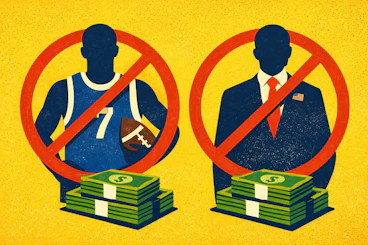
Kalshi Moves to Ban Athletes and Politicians From Trading on Their Own Markets

Key Facts
- Kalshi said it will block professional and NCAA athletes, coaches, and other sports-connected figures from trading on contracts tied to the sports and leagues in which they work or play.
- The company also said political candidates and certain government-connected individuals are barred from trading on election markets they can influence.
- Enforcement now includes onboarding screening with IC360 for sports-related users, alongside existing compliance and surveillance systems.
- The announcement landed the same day senators advanced the bipartisan Prediction Markets Are Gambling Act, which would ban CFTC-regulated exchanges from offering sports contracts.
Kalshi Tightens Its Insider-Trading Controls as Pressure Builds
Kalshi announced on March 23 that it will preemptively block professional and college athletes, coaches, officials, and political candidates from trading on markets tied to their own teams, leagues, or campaigns. According to Axios, the company had already prohibited that conduct under its rules, but the change adds a front-end screening layer intended to stop those trades before they happen.
On Kalshi’s own market-integrity pages, the company says it works with outside vendors to screen users at onboarding and to block people from accessing markets where they may hold material non-public information or direct influence over the outcome.
For sports, Kalshi says that includes professional and NCAA athletes, coaches, trainers, officials, team staff, owners, and others tied to a sport or league. It also says IC360 supplies league-connected data used to identify and flag potential matches at signup.
For politics, Kalshi says it actively blocks members of Congress and other politicians from joining the platform, while its rules prohibit candidates and government employees from trading on contracts where they have non-public information or influence over the result. The company says it can freeze accounts, investigate flagged activity, and refer cases to law enforcement where appropriate.
Kalshi’s head of enforcement, Robert DeNault, told Axios the company is trying to reduce misconduct with tools that are practical rather than perfect, saying, “You’ll never stop all illicit activity everywhere,” but adding that the goal is to use available technology in ways that “make sense.”
Recent insider-trading cases helped force the issue
Kalshi’s policy shift follows a series of high-profile insider-trading controversies that turned a theoretical risk into a live compliance and political problem. Cases like the $500 million-plus Iran-strike market drew scrutiny because of unusual wallet activity and sharply timed positions, even if that alone did not prove misconduct. Those episodes gave critics a concrete example of how prediction markets can be vulnerable to traders with privileged information.
The same issue has surfaced in corporate markets too. The OpenAI employee fired over prediction-market insider trading showed that the risk is not limited to sports or politics, but can extend to any market where someone may know the outcome before the public does. Taken together, those cases help explain why operators are now under pressure to build stronger front-end controls instead of relying on rules and enforcement after the fact.
Kalshi itself has already publicized internal insider-trading enforcement, recently levying insider-trading fines against a politician and an employee of YouTube creator MrBeast, while saying it had opened 200 investigations, frozen some accounts, and turned a dozen investigations into active cases.
The timing was not accidental
The policy change arrived as prediction markets face intensifying political and regulatory pressure. Also on March 23, Senators Adam Schiff and John Curtis introduced the “Prediction Markets are Gambling Act”, which would bar prediction markets from listing sports-related contracts. Curtis said in a statement that “sports betting and casino-style gaming contracts belong under state control, not under federal regulators.”
That pressure had already been building. In a February 13 letter, Schiff and other senators told CFTC Chair Michael Selig that the commission had withdrawn prior guidance cautioning exchanges about sports-based event contracts and was moving in a direction they argued conflicted with the Commodity Exchange Act and state law. Schiff’s office repeated that criticism this week, saying the CFTC had reversed course on prediction markets tied to sports and other prohibited categories.
Why This Matters For Bettors

For bettors, the immediate significance is that Kalshi is acknowledging the core vulnerability critics have been hammering for months: a prediction market is far less credible if participants with direct influence, privileged access, or operational knowledge can trade into it. A platform that cannot police that risk consistently will struggle to win mainstream bettor trust, especially in sports, where integrity concerns already sit at the center of regulation.
This also matters because Kalshi is trying to show regulators that self-policing is possible without conceding the broader argument that its sports contracts should be treated like state-regulated sportsbook wagers. The company is not retreating from sports; it is trying to make the case that tighter controls should preserve the category. In practical terms, that could help Kalshi argue that prediction markets can manage integrity risk with exchange-style compliance rather than the state gaming model critics want imposed on them.
But the move is unlikely to satisfy the people pushing for a broader ban. The central criticism from lawmakers is not just that insiders might trade; it is that federally regulated event contracts now look and function too much like sports betting while bypassing state gambling frameworks, tribal interests, and state-level consumer protections. Blocking athletes and candidates may narrow one vulnerability, but it does not resolve the jurisdiction fight.
There is also a second credibility problem. Kalshi’s own rules already prohibit trading based on non-public information, trading on behalf of another person, and manipulative or deceptive conduct. The new screening layer helps, but it does not eliminate the harder cases involving friends, staff, family members, tippers, or loosely connected insiders. That means the industry still has to prove it can detect and deter misconduct beyond the most obvious direct participants.
What Happens Next
The next step is likely to play out on two tracks. One is legislative: the bipartisan Senate bill has given prediction-market critics a cleaner vehicle to challenge sports contracts directly. The other is enforcement: states and federal policymakers are still fighting over who gets to define these products and who gets to police them.
For Kalshi, that means more pressure to document how its controls actually work in practice. Screening at signup is a meaningful escalation, but regulators and critics will be looking for evidence that the system catches edge cases, not just headline examples.
For the broader market, this is another sign that prediction platforms increasingly understand compliance is no longer a side issue. It is central to whether sports-facing event contracts survive in anything close to their current form.
Related News


Marcus has spent over 20 years navigating the legal side of online betting - from his early days consulting for offshore operators to helping licensed U.S. sportsbooks launch in regulated markets. He’s worked with compliance teams, reviewed licensing frameworks in 15+ states, and advised on some of the biggest regulatory shifts since PASPA was repealed.
At BettingScanner, Marcus serves as the voice of reason - translating legalese into plain English and helping bettors understand what’s legal, what’s risky, and where the gray areas live. If you’re ever unsure about the rules, Marcus is your man - as he probably helped write them.


