
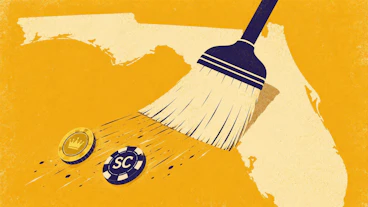
Florida Goes After Stake and VGW in Major Sweeps Crackdown

Key Points
- Florida filed separate lawsuits on August 19 against companies behind Stake.us and VGW brands including Chumba Casino, LuckyLand and Global Poker.
- The state alleges their dual-currency sweepstakes systems amount to illegal online gambling and violate Florida consumer-protection law.
- Florida is also suing payment companies it says helped facilitate transactions, extending the enforcement threat beyond the casino operators themselves.
- Attorney General James Uthmeier is relying on existing gambling and consumer laws rather than a newly enacted sweepstakes casino ban, a legal approach other states could attempt to copy.
Florida Targets Two of the Biggest Names in Sweepstakes Gaming
Florida Attorney General James Uthmeier filed two lawsuits Wednesday targeting Stake and VGW, escalating the state’s broader campaign against gambling businesses it considers illegal.
The complaints challenge the dual-currency structure used by online sweepstakes sportsbooks and casinos, where customers typically receive or purchase one virtual currency for entertainment play while a second currency can be used in games offering prizes redeemable for cash or other items.
Florida alleges that structure does not transform the underlying activity into a lawful sweepstakes. Instead, the state argues the operators are effectively offering unlicensed gambling to Florida customers.
VGW operates Chumba Casino, Global Poker and LuckyLand-branded products. The company describes its model as free-to-play social gaming supplemented by optional purchases and sweepstakes promotions offering players the opportunity to redeem prizes.
Stake.us similarly says its standard games use Gold Coins, while promotional games use Stake Cash that can potentially be redeemed for prizes. Its published terms state that no purchase is necessary to enter its sweepstakes.
Florida is asking the courts for injunctions against the alleged conduct as well as consumer restitution, disgorgement and civil penalties.
Payment Companies Are Also Being Pulled Into the Case
The lawsuits are notable for extending beyond the companies actually operating the casino platforms.
Florida has also named payment businesses that it alleges helped process transactions associated with the platforms. That approach attacks one of the most important dependencies in the sweepstakes casino business: the ability to move customer money through mainstream financial infrastructure.
Uthmeier had already signaled that payment companies were becoming part of Florida’s gambling enforcement strategy. During a June crackdown on illegal gaming operations, he called on payment processors to stop handling transactions for businesses operating illegally in the state.
If Florida establishes liability against companies that facilitate payments, processors and other vendors could become substantially less willing to service sweepstakes operators even in jurisdictions where those operators have not yet been directly banned.
Florida Says It Already Has the Laws It Needs
The other important piece of Florida’s case is what the state did not do first: pass a new law explicitly outlawing dual-currency sweepstakes casinos.
Instead, the attorney general is arguing that existing Florida gambling statutes and the Florida Deceptive and Unfair Trade Practices Act already provide sufficient authority.
Florida law recognizes legitimate game promotions and sweepstakes, but those promotions operate within statutory requirements. The Florida Department of Agriculture and Consumer Services says qualifying game promotions must be connected to the sale of consumer products or services, with additional registration and bonding requirements applying in some circumstances. Violations can also trigger action under Florida’s consumer-protection law.
The new lawsuits effectively ask the courts to determine whether the online casino model offered by Stake and VGW fits within those legal protections or crosses the line into gambling prohibited under existing law.
Why This Matters for Bettors

For players in Florida, the immediate risk is straightforward. Successful enforcement could remove or severely restrict access to some of the country’s largest sweepstakes platforms and affect customers with balances or pending redemptions.
The larger industry issue is Florida’s choice of legal weapon.
Sweepstakes operators have spent years fighting state-by-state regulatory pressure, and the industry has increasingly faced explicit bans, cease-and-desist orders and withdrawals from individual markets. VGW, for example, already excludes numerous states from promotional play, while Stake.us currently lists more than 20 states among its excluded territories.
A legislative ban gives operators a clearly defined date and rule change to respond to. An enforcement case based on existing gambling law is potentially harder to contain.
If Florida wins, attorneys general elsewhere would not necessarily need to wait for their legislatures to agree on bespoke sweepstakes legislation. States with similarly broad gambling and consumer-protection statutes could examine whether the same theory works under their own laws.
The payment-processor claims increase that pressure further. An operator can decide to contest a state’s interpretation in court. Banks, payment companies, game suppliers and technology vendors have less incentive to absorb legal risk merely to preserve one customer relationship.
That can create indirect market exits without a regulator ever securing a final judgment against the casino operator itself.
VGW has already been dealing with substantial contraction in the U.S. market. Its sweepstakes products were unavailable in a growing list of states before the Florida cases were filed, while the company announced in July that LuckyLand Slots would shut down completely in September.
Florida therefore lands as another significant test for a sector whose legal position is increasingly being challenged through several different channels at once.
What Happens Next
The first fight will be procedural. Stake, VGW and the other defendants can challenge Florida’s allegations, its interpretation of state gambling law and potentially whether Florida courts have jurisdiction over particular corporate entities.
No court has yet ruled that the allegations in these new lawsuits are proven.
For the wider sweepstakes industry, if financial providers begin treating sweepstakes casino transactions as an enforcement risk, platforms could face higher costs, fewer processing options and further state exits before courts settle the underlying legality of the model.
A favorable ruling for Florida would give regulators elsewhere something considerably more useful than another cease-and-desist letter: a tested legal theory they may be able to replicate.
Cole cut his teeth as a sportswriter in Texas, covering everything from Longhorns games to small-town Friday night lights. A lifelong bettor stuck with offshore books for over a decade thanks to Texas' slow path to legalization, he eventually found his way into the world of social sportsbooks - where he uncovered a fast-growing, community of bettors.
Today, he writes for the millions of Americans in states without legal books, helping them explore safe ways to bet without running afoul of the law.
As editor-in-chief, he aims to keep BettingScanner honest, human, and grounded in what bettors actually care about: fairness, fun, and finding your lane - even when the state won’t give you one.


