
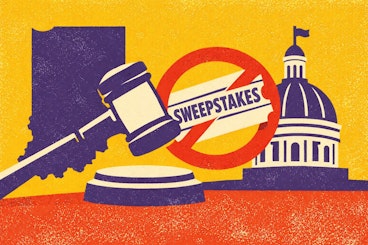
Indiana Senate Advances Amended Sweepstakes Ban Bill - What HB 1052 Means Next

Key Facts
- The Indiana Senate passed an amended version of HB 1052 on Feb. 17 by a 37-8 vote, sending it back to the House.
- The bill would define “sweepstakes game” in statute and authorize $100,000 civil penalties for violations tied to offering or facilitating online sweepstakes games in Indiana.
- Senate changes include an explicit carve-out stating the definition does not include state lottery offerings or “peer to peer skill-based poker games.”
- If the House doesn’t concur with the Senate edits, the bill can go to conference committee
The Senate moves HB 1052 - but the House has the final say
HB 1052 is no longer a straight “up-or-down” bill for the Indiana House. The Senate approved the measure on third reading by a 37-8 vote, but did so with amendments, which forces the bill back to the chamber where it originated. In practical terms, that means House leadership and the bill’s sponsors now have to decide whether they can live with the Senate’s version or whether they want to fight for the original House language.
When the Senate amends a House bill, the House typically has two paths:
- Concur with the Senate changes and send the bill onward in its amended form, clearing the way for final enrollment and transmission to the governor.
- Non-concur and send the legislation into a conference committee, where a small group of House and Senate members negotiates a compromise “conference report” that must then pass both chambers.
The time crunch is what makes that choice meaningful. Feb. 27 has been framed as the effective end-of-session runway for getting major bills to the finish line, even though Indiana’s official calendar also lists later legislative deadlines and an outside adjournment date.
What the bill targets, in plain terms
The amended language doesn’t try to outlaw “sweepstakes” as a broad marketing concept. It creates a very specific statutory definition that is engineered to capture the core operating model of sweepstakes-style sportsbook and casino sites: an online game or promotion that’s available on the internet, playable on common consumer devices, and run through a dual-currency or multi-currency system where a player can exchange currency for cash (or cash equivalents).
Just as importantly, the definition is not limited to a particular brand, genre label, or storefront. It turns on mechanics: if the product uses that multi-currency structure and the gameplay simulates lottery games or casino-style gambling - explicitly including slots, video poker, table games, bingo, and even sports wagering simulations - it is treated as a “sweepstakes game” under the bill.
What enforcement would look like under the amended bill
The Senate-approved approach is built around civil enforcement, not criminal prosecution.
Multiple reports and bill summaries describe a framework where the Indiana Gaming Commission would be empowered to impose civil penalties of up to $100,000 per violation tied to knowingly offering or conducting qualifying sweepstakes games online involving Indiana.
That distinction matters for operator behavior. Civil penalty regimes are generally designed to be fast-moving and compliance-driven - a way to force exits and deter “grey market” expansion without the heavier lift of criminal investigation and charging decisions.
The Senate’s poker carve-out is a notable change
The most material Senate change is a carve-out for “peer to peer skill-based poker games.” That language was advanced via an amendment attributed in coverage to Sen. Kyle Walker (R). The result is that sweepstakes-style poker platforms that use a dual-currency model are explicitly positioned differently than the casino-style sweepstakes products the bill is aiming at.
The Senate version also explicitly excludes state lottery offerings, contests, or promotions from the “sweepstakes game” definition, which helps limit unintended conflicts with lottery-run promotions and digital products.
Why This Matters For Bettors

Traditional sports bettors in Indiana won’t see their DraftKings/FanDuel-style access change as this bill is aimed at sweepstakes casino-style products, not regulated sportsbooks.
But there are two practical bettor-facing angles worth watching:
- If you use sweepstakes casinos as a substitute product, a ban with six-figure civil penalties is designed to force operators to exit rather than “test the line.”
- If you bounce between formats - sports betting, free-to-play/social products, and sweepstakes - Indiana is drawing a brighter boundary around what it considers permissible online gaming mechanics. That can influence what kinds of “play-for-prizes” promos and alternative games are available locally, even when they’re not marketed as gambling.
Indiana is also a bellwether for a broader state-level pattern: lawmakers are increasingly trying to settle the sweepstakes question with explicit statutory definitions and penalty structures, instead of leaving it to informal enforcement or attorney general pressure.
The pushback from sweepstakes industry advocates is equally direct. In a Jan. 22 statement after an earlier committee vote, Social Gaming Leadership Alliance managing director Sean Ostrow argued that “Social Plus games have been operating lawfully in Indiana since 2012,” and urged regulation over prohibition, saying “sensible regulation is the pragmatic pathway forward.”
Whether Indiana ultimately bans or revises the approach in conference, the outcome is likely to be cited in other statehouses weighing the same question - especially because the Senate version is trying to be more precise by carving out lottery offerings and peer-to-peer poker.
What Happens Next
The next steps are procedural but consequential:
- If the House agrees to the Senate’s amendments, HB 1052 can move to the governor.
- If the House rejects the changes, leadership can negotiate a single compromise version and send a conference report back to both chambers. A legislative tracker listed a conference committee hearing for Feb. 23.
- Lawmakers are targeting adjournment by Feb. 27 for the 2026 session, compressing the runway for any back-and-forth.
Related News


Cole cut his teeth as a sportswriter in Texas, covering everything from Longhorns games to small-town Friday night lights. A lifelong bettor stuck with offshore books for over a decade thanks to Texas' slow path to legalization, he eventually found his way into the world of social sportsbooks - where he uncovered a fast-growing, community of bettors.
Today, he writes for the millions of Americans in states without legal books, helping them explore safe ways to bet without running afoul of the law.
As editor-in-chief, he aims to keep BettingScanner honest, human, and grounded in what bettors actually care about: fairness, fun, and finding your lane - even when the state won’t give you one.


