
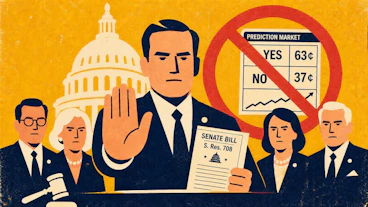
Senators Ban Themselves From Betting On Prediction Markets

Key Facts
- The Senate passed S. Res. 708 by unanimous consent April 30, prohibiting Senate members, officers and employees from entering into event contracts tied to whether a specific event occurs.
- Sen. Bernie Moreno sponsored the resolution; Sen. Alex Padilla’s amendment broadened the restriction beyond senators and encouraged similar rules for the House, executive branch and judiciary.
- The action follows heightened scrutiny of insider-risk cases involving event contracts, including recent CFTC enforcement activity tied to misuse of nonpublic information and fraud on Kalshi.
Senate Moves To Block Insider Risk on Prediction Markets
The U.S. Senate approved a new conflict-of-interest rule Thursday prohibiting senators, officers and employees from trading on prediction markets, a category that includes event contracts tied to political, economic, legal and geopolitical outcomes.
The measure passed by unanimous consent, meaning no senator objected to its adoption. The Senate Periodical Press Gallery recorded the passage of S. Res. 708 with the Padilla amendment as a change to Rule XXXVII of the Standing Rules of the Senate, effective immediately.
Sen. Bernie Moreno, R-Ohio, sponsored the resolution. In a statement, Moreno said:
United States Senators have no business engaging in speculative activities like prediction markets while collecting a taxpayer-funded paycheck, period.
He added that serving in Congress “should never be about finding new ways to profit.”
What The New Senate Rule Covers
The resolution amends Senate Rule XXXVII, the chamber’s conflict-of-interest rule. The text bars covered Senate personnel from entering into, or offering to enter into, an agreement, contract, swap or transaction involving an excluded commodity when payment or delivery depends on the occurrence, nonoccurrence or extent of occurrence of a specific event or contingency.
Padilla’s amendment made two important changes:
- It extended the ban from senators to Senate officers and employees
- It clarified that the restriction should not apply to insurance contracts where the insured has a lawful insurable interest.
The amendment also added a sense of the Senate that the House, executive branch and judicial branch should establish similar restrictions.
The Senate is not banning all gambling, all financial trading or all sports betting by its members and staff. It is targeting event contracts that could be affected by government action or nonpublic information.
Why Staff Were Added To The Ban
Padilla, D-California, said his amendment was intended to close a significant loophole by including officers and employees of the Senate.
In a statement, Padilla said the rule responds to concerns over “politicians betting on their own races” and “suspected insider trading” tied to sensitive government events.
Staff can have access to briefings, legislative calendars, committee materials, national security information and draft policy language before it becomes public. A ban that covered only elected senators would have left a large class of politically connected market participants outside the rule.
The Senate Ethics Committee is expected to interpret and enforce the amended rule and issue more detailed guidance for Senate employees.
The Ban Lands During A Broader Prediction Markets Fight
The Senate action comes as federal regulators, lawmakers and state officials are debating how prediction markets should be governed in the U.S.
The CFTC’s Division of Enforcement issued a prediction markets advisory Feb. 25 after two enforcement cases involving misuse of nonpublic information and fraud related to event contracts traded on Kalshi.
Separately, Sens. Kirsten Gillibrand, D-New York, and Dave McCormick, R-Pennsylvania, introduced the Prediction Market Act of 2026 on the same day the Senate adopted its internal rule. Their bill would ban members of Congress, the president, vice president and senior executive branch officials from trading event contracts, while directing the CFTC to create insider-trading standards for prediction markets.
Gillibrand said in a statement that elected officials should not be “lining their own pockets with insider information,” adding that markets should be “fair, transparent, and not tilted in favor of those with privileged access.”
Why This Matters For Bettors

For prediction market traders, the risk around prediction markets has always been bigger than whether a platform is technically available in their state. The sharper question is whether the market is clean enough to trust.
Prediction markets depends on participants trading against one another, which means the integrity of the price depends heavily on the integrity of the participants. If someone with access to classified briefings, closed-door negotiations, committee votes or enforcement plans can trade before the public knows what is happening, regular users are not competing in an open market. They are providing liquidity to someone with a better information position.
For users, the practical impact is price quality. A market with insider flow can still settle correctly, but its odds may stop reflecting public probability and start reflecting privileged access. That can make prices look smarter than they are, move markets before news breaks and leave ordinary traders buying stale or already-contaminated numbers. In a thin market, even a relatively small amount of informed trading can distort the price.
The broader industry implication is that prediction markets are moving into a phase familiar to sportsbooks: growth brings oversight, and oversight brings rules that can change the product. If regulators and lawmakers conclude that certain markets are too exposed to insider abuse, platforms may face limits on political contracts, government-action markets, military or foreign-policy events, or markets involving participants who can influence the outcome.
That is why the Senate vote matters beyond Capitol Hill. The Senate just acknowledged that these markets are no longer a novelty product sitting outside the political system. They are now important enough for Congress to restrict its own access.
What Happens Next
The Senate rule is immediate, but its larger effect depends on whether other branches follow.
The Padilla amendment explicitly encourages the House, executive branch and judicial branch to adopt similar restrictions. That language is not binding, but it gives lawmakers a clear template for expanding the policy beyond one chamber.
The next regulatory battleground is likely to be broader federal legislation. The Prediction Market Act of 2026 would go further than the Senate rule by applying restrictions to elected officials and senior executive branch officials, while directing the CFTC to define insider-trading standards specific to event contracts.
Platforms should expect more pressure to show that they can identify prohibited traders, detect suspicious activity and separate ordinary retail speculation from trading based on nonpublic information. That is especially important for markets tied to elections, military action, legislation, economic data and regulatory decisions.
For bettors, the near-term product experience may not change much. The longer-term effect could be more meaningful: fewer politically sensitive markets, tighter eligibility rules, stronger know-your-customer checks and clearer enforcement standards. That would make prediction markets less open-ended than their early advocates may prefer, but more credible for users who want a market that is not quietly being picked off by insiders.
Marcus has spent over 20 years navigating the legal side of online betting - from his early days consulting for offshore operators to helping licensed U.S. sportsbooks launch in regulated markets. He’s worked with compliance teams, reviewed licensing frameworks in 15+ states, and advised on some of the biggest regulatory shifts since PASPA was repealed.
At BettingScanner, Marcus serves as the voice of reason - translating legalese into plain English and helping bettors understand what’s legal, what’s risky, and where the gray areas live. If you’re ever unsure about the rules, Marcus is your man - as he probably helped write them.


