
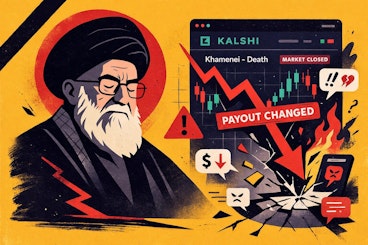
Kalshi’s Khamenei Market Payout Change Causes User Backlash - Explained

Key Facts
- Kalshi’s CEO said the platform would settle positions at the last trading price before Khamenei’s death, citing a rule against markets directly tied to death, while also refunding fees and reimbursing post-event purchases.
- Critics argue the contract’s wording effectively implied death was the only realistic path, making the settlement change feel like a midstream rewrite.
- A Wall Street Journal report said Kalshi refunded $2.2 million in fees tied to the market as the controversy escalated.
- Polymarket hosted similarly worded markets and, as of reporting, appeared not to adjust payouts - highlighting how different platforms handle edge cases and reputational risk.
Kalshi changed how it paid the “Khamenei out” market after his reported death
The Wall Street Journal reported that Ayatollah Ali Khamenei was killed in a U.S. and Israeli strike on February 28, 2026, and that the betting dispute that followed pulled both Kalshi and Polymarket into the political and regulatory spotlight.
Kalshi users traded on a market asking whether Iran’s Supreme Leader Ali Khamenei would be “out” as Supreme Leader by a set deadline. After news reports said Khamenei had been killed, Kalshi announced it would not pay the market as a normal “Yes/No” resolution tied to him leaving power. Instead, Kalshi said it would settle positions based on the last traded price before the death was reported, and it would refund fees and reimburse certain late purchases tied to post-event trading activity.
That decision triggered backlash from some traders who said the contract and its payout expectations were not communicated clearly enough up front - especially because, in practical terms, Khamenei leaving power without dying was viewed by many users as highly unlikely.
Users say the market felt designed to be death-adjacent
On its face, the market is straightforward: you’re taking a position on whether a political figure will still hold office by a specific date. That kind of contract is common on prediction platforms because it can be resolved using public reporting and official announcements.
The core complaint isn’t just that people lost money. It’s that the market’s plain-English framing - Khamenei being “out” - was viewed by many traders as a proxy for the most obvious route to that outcome. If the most realistic way the contract resolves “Yes” is through death, then traders effectively feel they’re in a death-linked market - even if the contract is drafted as an “out of office” question rather than “dies by X date.”
Users have been vocal about the rules and boundaries around “profiting from death” not being communicated clearly enough, and that Kalshi could have avoided confusion by offering a tighter, non-death proxy, for example, a resignation-specific contract.
That’s the trust problem: if the most likely path to “Yes” is an event the platform later says it won’t recognize for full payout, traders will feel like the contract was tradable right up until it wasn’t - even if the company believes it’s enforcing a longstanding policy.
Kalshi's explanation
Kalshi’s public explanation, delivered by CEO Tarek Mansour in an X statement cited by The Verge, was straightforward: the platform would not “have a market directly settling on someone’s death,” and would instead settle the “Ali Khamenei out as Supreme Leader?” market at the last trading price before his death. Mansour also said Kalshi would refund fees tied to the market and reimburse purchases made after the death.
Kalshi’s own market page included language addressing that exact edge case. It states that if Khamenei leaves solely because he has died, the exchange will determine payouts based on the last traded price prior to his death.
So the settlement method Kalshi used wasn’t presented as an improvised decision after the fact - it’s described in the market’s published terms. Where users still object is the practical question of whether that clause was prominent and intuitive enough for traders, and whether the market should have existed in that form if the platform considers death-linked settlement off-limits in principle.
Why this turned into a bigger platform credibility fight
The backlash isn’t just about this single contract. It’s about whether traders can treat prediction markets as a straightforward instrument where outcomes resolve cleanly under published rules, or whether sensitive topics introduce an extra layer of platform judgment that can materially change expected payouts.
It also sharpened comparisons between platforms. Polymarket listed closely related markets and did not make the same kind of settlement adjustment, which underlines a key reality for users: two venues can offer similar-looking contracts but apply different standards when an outcome intersects with prohibited categories or reputational risk.
That difference affects where traders choose to participate and how they price the risk of a contract being modified, voided, or settled in an unexpected way.
Why This Matters For Bettors

Even if most sports bettors aren’t trading geopolitics, the practical lesson is familiar: settlement rules are everything.
On a sportsbook, most markets settle on a clearly defined stat or official result. On prediction platforms, you’re often betting on language: “removed from power,” “forcibly,” “by X date,” “confirmed by credible reporting,” and so on. Polymarket’s own Khamenei market rules show how much weight is carried by definitions - such as what counts as “removed from power,” and which sources determine it.
If you use prediction markets as an alternative to sports betting - especially in states without legal sportsbooks - this is the reminder to treat them like contract trading, not a standard bet slip. If the resolution criteria or prohibited categories aren’t crystal clear, you’re taking on extra risk that has nothing to do with being right.
What Happens Next
Kalshi has already taken steps to blunt the reputational hit - including refunds that the WSJ reported totaled $2.2 million in fees tied to the market. The bigger question is whether the controversy triggers:
- More explicit “death-adjacent” guardrails - such as banning certain phrasings, adding clearer prohibited-category disclosures, or forcing markets into narrower, non-death definitions.
- Greater scrutiny from policymakers who argue these markets can resemble assassination or war proxies.
- A platform split where offshore/crypto-first venues keep listing edgy markets, while U.S.-regulated venues either avoid them or settle them with more conservative, pre-defined mechanisms.
For bettors, the actionable takeaway is simple: if a market’s resolution hinges on a sensitive edge case, assume the platform’s risk team is watching it - and price in the possibility that how it resolves becomes part of the wager.
Related News


Marcus has spent over 20 years navigating the legal side of online betting - from his early days consulting for offshore operators to helping licensed U.S. sportsbooks launch in regulated markets. He’s worked with compliance teams, reviewed licensing frameworks in 15+ states, and advised on some of the biggest regulatory shifts since PASPA was repealed.
At BettingScanner, Marcus serves as the voice of reason - translating legalese into plain English and helping bettors understand what’s legal, what’s risky, and where the gray areas live. If you’re ever unsure about the rules, Marcus is your man - as he probably helped write them.


