
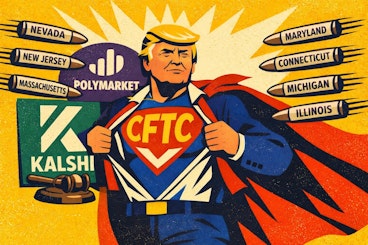
Trump Administration Mobilizes Federal Regulators to Shield Prediction Markets From State Bans

Key Facts
- The CFTC has filed an amicus brief in the Ninth Circuit backing prediction-market operators in a case tied to Nevada’s enforcement actions
- CFTC Chair Michael Selig says state efforts to restrict these markets undermine federal authority and decades of precedent.
- States counter that these platforms function like unlicensed sports betting, pointing to how much trading volume is sports-related.
- The dispute could decide whether prediction markets can operate nationally under one federal rulebook or face state-by-state shutdown risk.
Federal regulators are taking a side - in public and in court
The CFTC’s escalation is formal as well as rhetorical. The agency announced it had filed an amicus brief in the U.S. Court of Appeals for the Ninth Circuit “confirming its exclusive jurisdiction” over U.S. commodity derivatives markets, including “event contract markets commonly referred to as prediction markets.”
In that same release, Chairman Michael S. Selig wrote that the commission “will no longer sit idly by”, framing the dispute as a direct challenge to federal authority:
CFTC-registered exchanges have faced an onslaught of lawsuits seeking to limit Americans’ access to event contracts and undermine the CFTC’s sole regulatory jurisdiction over prediction markets.
Selig also tied the products to financial-market use cases rather than gambling regulation, arguing that:
Event contracts allow businesses and individuals to hedge event-driven risks, enable investors to manage portfolio exposure, and provide the public with information about the outcome of future events.
That’s the core of the administration-aligned posture you’re aiming at: the federal regulator isn’t merely observing state enforcement efforts - it’s asserting the CFTC’s authority as the governing framework and warning states off.
What the CFTC is claiming, in plain terms
The federal position is a jurisdictional one: prediction markets are being framed as event contracts governed by the Commodity Exchange Act, meaning the regulator is the CFTC rather than state gambling commissions.
The argument is that these products function more like derivatives contracts than like sportsbook wagers - participants are trading positions with each other in a market, not placing bets against an operator acting as “the house.”
CFTC Chair Michael Selig has also emphasized the claimed economic purpose of these contracts: that they can support hedging and price discovery, and that the public prices generated by trading can convey information about expected outcomes. In that framing, state bans are not just a policy disagreement - they are treated as an attempt to regulate a federally supervised derivatives product through state gambling law.
States say it’s still gambling - especially when the activity looks like sports betting
State regulators and attorneys general pushing enforcement actions argue that - regardless of the federal label - many of these sports contracts walk and talk like betting when they are tied to game outcomes. Their case is practical rather than academic: when contracts mirror familiar sportsbook markets, states say they should be treated as gambling and subject to state licensing, consumer protections, and enforcement.
States are also leaning on the composition of activity on these platforms. Where trading is heavily concentrated in sports-related contracts, they argue the product is effectively an end-run around state betting regimes - particularly in jurisdictions that restrict sports wagering or require operators to be licensed and taxed locally.
In short, the state view is that “event contract” terminology should not determine legality if the underlying consumer experience and economic reality resemble wagering on sports.
Why This Matters For Bettors

For sports bettors, the practical issue is not philosophical - it’s access and product availability.
If the CFTC’s preemption theory prevails broadly, prediction markets would have a clear path to continue operating nationally under federal supervision, including in states that restrict or prohibit sports betting. That could expand the footprint of sports-like yes/no markets outside the state-by-state sportsbook licensing model bettors are used to.
A federal win would weaken states’ ability to police products they view as wagering, potentially creating a parallel nationwide channel for event-based markets.
A state win - or even a narrow federal ruling - would reinforce a fragmented environment where platforms face cease-and-desists, litigation, and forced geofencing across multiple jurisdictions.
Selig has pointed to Congress as the place to settle broader policy questions - less about who regulates and more about what should be allowed in event contracts, including who should be permitted to trade them.
What Happens Next
Near-term, the signal is that the CFTC is prepared to litigate. Selig’s public posture has hardened into a strategy: use the agency’s court filings and public statements to deter state-by-state prohibitions and push disputes into federal venues where preemption arguments are strongest.
At the same time, the market is unlikely to get clarity solely from one case. With multiple states taking action and the CFTC asserting exclusive jurisdiction, the path runs toward either appellate precedent that others follow - or eventual congressional action to draw a bright line around what event contracts can cover, particularly in sports-adjacent markets.
Related News


Marcus has spent over 20 years navigating the legal side of online betting - from his early days consulting for offshore operators to helping licensed U.S. sportsbooks launch in regulated markets. He’s worked with compliance teams, reviewed licensing frameworks in 15+ states, and advised on some of the biggest regulatory shifts since PASPA was repealed.
At BettingScanner, Marcus serves as the voice of reason - translating legalese into plain English and helping bettors understand what’s legal, what’s risky, and where the gray areas live. If you’re ever unsure about the rules, Marcus is your man - as he probably helped write them.


