
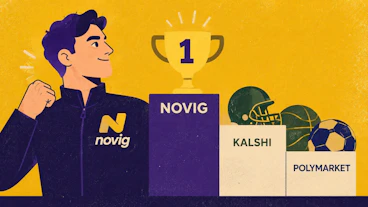
Novig Says Its First Week Beat Kalshi and Polymarket’s Sports Debuts

Key Points
- Novig reported more than $125 million in notional trading volume during the first week after its Aug. 4 nationwide launch.
- CEO Jacob Fortinsky said the platform’s biggest day reached $26.3 million in volume.
- Novig says its first-week total exceeded the comparable sports debuts of Kalshi, Polymarket U.S., Underdog and DraftKings’ DKeX, based on figures compiled by Novig.
- Roughly one-third of opening-week activity came from parlays, while baseball generated more volume than any other sport, according to people familiar with the activity.
Novig Opens Its National Run With Nine-Figure Volume
Novig reported more than $125 million in notional trading volume during the seven days following its Aug. 4 national launch, immediately giving the sports-focused prediction market a sizable headline number to take into football season.
The company launched nationally after receiving designation from the Commodity Futures Trading Commission as a Designated Contract Market. In its launch announcement, Novig said the move gave it nationwide reach under a federally regulated model, alongside deeper liquidity, faster live trading and expanded payment options.
Novig Says Its Debut Outpaced Rival Sports Launches
The eye-catching comparison is not only the $125 million figure. Novig says its opening week produced more volume than the corresponding sports-market debut weeks for Kalshi, Polymarket U.S., Underdog and DraftKings’ DKeX.
Of course, this comparison needs some context. The figures were compiled by Novig, and the platforms did not all enter the sports prediction market business under identical conditions. Kalshi, for example, existed for years before sports became a major part of its product, while the current market is considerably more established and visible than it was during some competitors’ launches.
Still, $125 million during the low season is difficult to dismiss as trivial launch traffic. Fortinsky said Novig’s highest-volume day since going nationwide reached $26.3 million.
Parlays Are Already a Major Part of the Mix
Perhaps the more revealing number for bettors is the product mix.
People familiar with Novig’s activity told CNBC that parlays generated roughly one-third of first-week volume. Baseball, meanwhile, was the platform’s highest-volume sport.
That combination says plenty about where sports-focused prediction markets are heading. The category may use exchange language and financial-market infrastructure, but the products attracting action increasingly resemble the ones bettors already understand.
Novig currently lists moneylines, spreads, props, futures and parlays, giving it a sports-first menu rather than treating sports as one event category among politics, economics and culture.
Novig Is Keeping Its Minimum Age at 21
Novig is also taking a different position on customer eligibility than competitors that permit users from age 18.
The company requires participants to be at least 21 and has described that restriction as a voluntary policy rather than a federal regulatory minimum. At launch, Fortinsky said Novig was maintaining the requirement as part of its approach to responsible participation.
Fortinsky returned to the point after the opening-week numbers were released, writing that Novig had generated more than $125 million despite being a 21+ platform and therefore “intentionally not capturing the entire market.”
Why This Matters For Bettors

For bettors, $125 million matters primarily because trading venues live and die on liquidity.
A prediction market can have a polished interface and hundreds of markets, but thin order books can still produce poor execution and make larger positions difficult to enter or exit at the displayed price. Sustained volume gives a platform a better chance of producing competitive markets, tighter pricing and enough counterparties for users to trade without moving the market against themselves.
One week does not prove Novig has reached that point. Notional volume also should not be confused with revenue, deposits or money won by customers. What the opening figure does show is that Novig has been able to attract meaningful trading activity immediately after expanding nationally.
The baseball result is particularly interesting. Fortinsky described August as “one of the slowest months on the sports calendar” when discussing the launch numbers. If Novig can sustain that activity as college football and the NFL return, the more useful test will be whether liquidity expands across sports and market types rather than simply producing a large launch-week total.
The parlay share may be even more consequential for the wider industry. Prediction markets initially built much of their appeal around simple binary contracts and exchange-style price discovery. If parlays become a major volume driver, sports platforms are moving closer to the product behavior that has made same-game parlays so important to conventional sportsbooks.
For Novig, that creates a clearer competitive lane. Kalshi and Polymarket can offer enormous breadth across real-world events. Novig is betting that a product designed specifically around sports can compete through market depth, familiar bet types and execution rather than trying to offer a contract on everything happening in the news.
There is also an important limit to the launch-week comparison. Debut volumes across Kalshi, Polymarket U.S., Underdog and DKeX occurred at different stages of the prediction market cycle, with different products and different addressable audiences. Novig winning that particular comparison is useful evidence of demand, but it does not establish that the platform has already overtaken those competitors in ongoing sports liquidity.
What Happens Next
Football is the real test.
If Novig can carry its baseball-led launch volume into the NFL and college football seasons, its opening week will look more like evidence of durable liquidity than launch-week curiosity. Bettors should watch pricing, market depth and execution rather than headline notional volume alone.
The other question is competitive response. If parlays and sports-first trading continue to drive volume, Kalshi, Polymarket and other platforms will have more incentive to deepen their own sports products.
Ari started his gaming career as a poker grinder, then a crypto trader, before stumbling onto prediction markets. He’s now deep into betting on everything from politics to pop culture to tech layoffs. If it has uncertainty and odds, Ari’s in.
Skeptical by nature, Ari is fully convinced that the weirdest bets often hide the sharpest edges. If you’ve ever wondered whether it’s possible to beat the market by reading the news better than everyone else - Ari’s here to show you how.


