
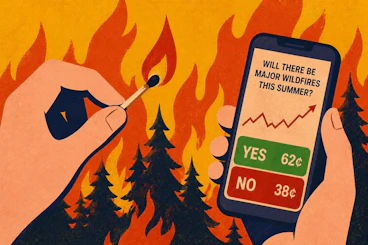
People Are Betting on Wildfires. Senators Fear What Comes Next

Key Points
- Nine senators asked the CFTC whether it plans to prohibit federally regulated prediction markets from offering wildfire contracts.
- Polymarket accepted more than $1.2 million in trades tied to the January 2025 California wildfires, according to the senators’ letter.
- Lawmakers warned that contracts based on fire containment, destruction and growth could incentivize traders to influence the outcome.
- The senators gave the CFTC until August 14 to explain whether it considers wildfire contracts to be in the public interest.
Nine Senators Demand Federal Action on Wildfire Markets
Nine Democratic senators asked Commodity Futures Trading Commission Chairman Michael Selig to restrict event contracts that allow traders to profit from the duration, growth or destruction caused by wildfires.
The August 3 letter was led by Oregon Senator Jeff Merkley and signed by Alex Padilla, Jeanne Shaheen, Adam Schiff, Jacky Rosen, Catherine Cortez Masto, Martin Heinrich, Ron Wyden and Amy Klobuchar.
“Offering bets on destructive wildfires threatens to minimize communities’ suffering all so the rich and powerful can profit,” the senators wrote.
They also warned that traders could be “tempted to commit arson in order to make sure their bets are successful” or interfere with an existing fire to move a market in their favor.
The letter does not identify an arson case connected to a wildfire contract. The lawmakers are asking the regulator to act before such incentives produce a documented incident.
Polymarket’s Los Angeles Fire Contracts Drew Major Trading
The senators focused on contracts offered through Polymarket’s offshore platform during the Palisades and Eaton fires that devastated the Los Angeles area in January 2025.
According to the letter, more than $1.2 million was traded across markets connected to the fires. Traders could take positions on questions including when a fire would be contained, how many acres would burn and whether flames would reach particular communities.
Polymarket’s market pages show the scale of individual contracts. A market on when the Palisades fire would be fully contained generated approximately $711,600 in trading volume. Another asking how many acres the fire would burn by Friday recorded roughly $347,400.
Smaller contracts allowed traders to bet on whether the fire would spread to Santa Monica, Malibu or Beverly Hills by a specific deadline.
The markets were settled using official fire data and credible reporting. That may provide an objective resolution mechanism, but it also ties traders’ financial positions directly to emergency conditions that can be influenced by human behavior.
Senators Want Wildfire Contracts Judged on Public Interest
The senators asked the CFTC whether contracts covering three specific outcomes should be permitted:
- How long a wildfire lasts
- How much a wildfire destroys
- How much a wildfire grows
They also asked whether the agency plans to prevent CFTC-regulated designated contract markets from listing similar products and how it intends to address contracts available through offshore platforms.
The letter says wildfire markets currently appear limited to Polymarket’s offshore operation. It does not claim that Kalshi or another U.S.-regulated exchange is presently offering real-money wildfire contracts.
Neither Polymarket nor the CFTC responded to requests for comments.
The CFTC Is Already Reconsidering Event-Contract Rules
The demand arrives while the CFTC is developing a new framework for deciding when event contracts involve gaming, war, terrorism, assassination or conduct prohibited under state or federal law.
Under the proposal published in June, the agency could apply a 90-day review and a set of public-interest factors to contracts falling within those categories.
“The CFTC will protect the integrity of our regulated markets without standing in the way of responsible innovation,” Selig said when announcing the proposal.
Wildfires are not expressly named among the categories listed in the Commodity Exchange Act. The regulatory question is whether these markets can be reviewed as gaming, involve unlawful conduct or otherwise fall within the CFTC’s authority to reject contracts that are contrary to the public interest.
Why This Matters for Bettors

For most U.S. bettors, the immediate impact is minimal. The senators sent a letter, not a ban, and the wildfire contracts they identified were offered through Polymarket’s offshore platform. Nobody’s NFL Sunday is about to change because Congress discovered disaster betting.
Wildfire markets still expose an uncomfortable limit for the prediction market industry. These platforms often present markets as neutral tools for measuring what people collectively believe will happen. That argument works reasonably well when traders are forecasting an election or an economic report. It gets much harder to defend when someone’s position becomes more valuable as a fire spreads through another neighborhood.
The risk is not limited to arson. Firefighters, utility workers, public officials and residents can possess information before it becomes public, while a person close to the emergency may be able to influence containment, reporting or evacuation conditions. Even if nobody ever acts on that incentive, building the incentive into the market is reckless product design.
There are plenty of awful things people would bet on if given the opportunity. That does not mean every grim curiosity needs an order book. If prediction platforms cannot draw credible boundaries themselves, lawmakers and regulators will draw those boundaries for them, probably with a much thicker marker.
Bettors may ultimately lose access to a small category of disaster markets that most will never touch. The larger danger for the industry is that wildfire betting gives its critics a brutally effective exhibit: a market where “better information” and “profit from greater destruction” can become the same trade.
What Happens Next
The senators requested answers from the CFTC by August 14. The agency has been asked to explain whether it will prohibit regulated exchanges from listing wildfire contracts, issue enforcement guidance or pursue offshore platforms offering the markets.
A response would not automatically create a ban. Formal restrictions on U.S.-regulated exchanges would most likely need to emerge through the CFTC’s event-contract rulemaking, a contract-specific review or new congressional legislation.
Polymarket could also remove wildfire markets voluntarily or introduce restrictions intended to reduce manipulation and insider trading. The platform had not publicly announced such changes when the senators issued their letter.
The CFTC’s authority over an offshore market presents a separate enforcement problem. Even if federally regulated exchanges are prevented from listing wildfire contracts, traders may still find similar products outside the U.S. regulatory system.
The most likely short-term effect is greater caution across the industry. A wildfire contract may generate trading volume, but it also hands lawmakers an example capable of shifting the prediction market debate away from abstract jurisdictional arguments and toward the possibility that a financial incentive could encourage someone to make a disaster worse.
Ari started his gaming career as a poker grinder, then a crypto trader, before stumbling onto prediction markets. He’s now deep into betting on everything from politics to pop culture to tech layoffs. If it has uncertainty and odds, Ari’s in.
Skeptical by nature, Ari is fully convinced that the weirdest bets often hide the sharpest edges. If you’ve ever wondered whether it’s possible to beat the market by reading the news better than everyone else - Ari’s here to show you how.


