
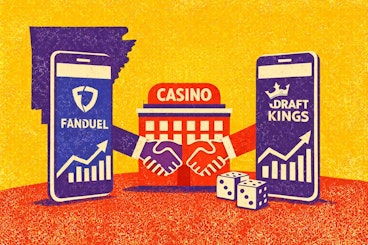
FanDuel and DraftKings Apply to Partner With Arkansas Casinos - What It Means for AR Bettors

Key Facts
- FanDuel and DraftKings have applied to operate in Arkansas through third-party partnerships with licensed casino operators.
- Arkansas’ model requires mobile operators to “tether” to one of three casinos and share at least 51% of sports betting revenue with that in-state partner.
- Coverage has pointed to the Racing Commission’s late-February meeting window as an early decision point, with some reports suggesting a path to launching shortly after approval.
FanDuel and DraftKings filed for Arkansas market access through casino partners
FanDuel and DraftKings have each submitted applications to the Arkansas Racing Commission to operate as third-party mobile sports betting partners tied to one of the state’s licensed casino operators.
Arkansas Racing Commission’s spokesperson, Scott Hardin, outlined where those applications currently point: DraftKings has applied to partner with Southland Casino Hotel in West Memphis, while FanDuel has applied to partner with Oaklawn Racing Casino Resort in Hot Springs.
Hardin also emphasized the structure is two-part: a partnership is only viable if the Racing Commission approves the third party and the casino ultimately chooses to do business with that operator - meaning regulatory approval alone doesn’t necessarily equal a guaranteed launch.
Arkansas’ rules force national brands to tether to casinos - and give casinos the bigger slice
Arkansas’ mobile market is built on a casino-tethered model. The state’s three casino licensees - Oaklawn (Hot Springs), Southland (West Memphis), and Saracen (Pine Bluff) - serve as the gatekeepers for online sports betting access, with the Racing Commission overseeing approvals for any third-party sportsbook arrangement.
What has historically made Arkansas a tough sell for the biggest national operators is the mandated economics. Under the state’s framework as described in multiple reports, a third-party sportsbook partner must remit at least 51% of sports betting revenue to its in-state casino partner.
That revenue split matters because it changes the business case. In most states, major brands pay for market access through upfront fees, revenue-share agreements, or both - but not typically in a way that formally guarantees the local partner the majority of revenue on an ongoing basis. Arkansas’ approach effectively hard-codes casino leverage into the mobile model, which is a major reason coverage has long cited for why national operators have stayed out.
The decision path is administrative, not legislative - and the calendar is tight
Unlike states where expansion requires a new bill, the next move in Arkansas is an administrative one: the Racing Commission can consider the applications and vote. Hardin described a process where, if approved, operators could begin offering mobile wagering without requiring legislative action.
Several reports have pointed to the Commission’s late-February meeting window - including a widely cited Feb. 26 date - as an early inflection point, which is why some coverage has suggested a path to going live before the end of the month if approvals come quickly.
Why This Matters For Bettors

For Arkansas bettors, the most immediate impact isn’t a change in legality - it’s the possibility of a meaningfully different mobile experience. Arkansas already offers statewide mobile sports betting, but the market has been built around in-state casino brands and their existing digital products, like Saracen’s BetSaracen app.
If approved, FanDuel and DraftKings would bring to Arkansas two of the most developed mobile sportsbook products in the U.S. market. That usually shows up in three places: market depth (more bet types and alternates), parlay and prop tooling (including same-game parlay flows that are designed to be built quickly), and live betting (a dedicated in-game hub with frequently updated lines and game-tracking that supports faster decisions).
In a state with a limited, locally branded set of mobile options, that kind of product maturity will be a huge step up for most AR bettors.
That said, bettors should keep expectations grounded on one point: Arkansas’ economics are unusually casino-favorable. A mandated majority revenue share to the casino partner creates less margin for the national operator than in many other states, which can influence how aggressive they are with promos and reinvestment over the long run.
What Happens Next
The near-term sequence is straightforward:
- Racing Commission review and vote: The commission will decide whether to approve FanDuel and DraftKings as eligible third-party partners.
- Partner execution: Even with approval, the casino-side partnership still has to be operationalized - contracts, integrations, compliance testing, and internal sign-off.
- Potential quick launches: If the commission acts at its late-February meeting and the operational pieces are in place, multiple reports have suggested a path to launching shortly after approval.
The one thing worth watching closely is whether Saracen responds competitively. Saracen already has statewide mobile wagering via BetSaracen, and a two-heavyweight entry scenario could force faster promo and product evolution across the market.
Related News


JD has been betting since 2009, back when his bookie was a guy named Vin who ran lines out of Philly. He survived the sketchy offshore days (barely) and made the jump to regulated sportsbooks the second New Jersey legalized in 2018. Since then, he’s turned hunting bonuses and exploiting odds boosts into an art form.
These days, JD specializes in helping new bettors skip the rookie mistakes, as well as showing seasoned ones how to play the promo game like a pro. If there’s a bonus to be had or a line that doesn’t look right, JD’s probably already on it.


