
Prediction Markets 101
Are Prediction Markets Legal in the United States?
Prediction Markets can look like betting, but their legality comes down to regulation, jurisdiction, and what the contract is actually classified as.
This guide will explain:
- Is it legal to use Prediction Markets?
- How they differ from gambling under U.S. law
- Why state sports betting laws do not control them
- The difference between CFTC-regulated and decentralized platforms
- Which prediction markets are federally regulated and available in your state
Is it legal for me to use Prediction Markets?
This guide is for educational purposes, not legal advice. U.S. rules and enforcement positions can evolve, and availability may vary by state.
Before trading, you should review the rules that apply in your jurisdiction and confirm that any platform you use is authorized to operate in the United States.
For most beginners, this is the first serious question.
Before you create an account, make a deposit or place your first trade, this is the first thing you will want to know clearly:
The short answer: Yes - but only when your prediction market of choice operates as a federally regulated exchange.
In the U.S., legal prediction markets are structured as event contracts traded on exchanges that are regulated by the Commodity Futures Trading Commission (CFTC). These platforms are registered entities, subject to federal oversight, compliance rules, reporting requirements, and customer protections - similar to other derivatives exchanges like the Chicago Mercantile Exchange (CME Group) or Cboe Futures Exchange.
That regulatory status is what makes them legal to use nationwide.
What Is an Event Contract?
An event contract is a financial-style contract that pays out based on whether a specific, clearly defined outcome happens.
For example:
- Will U.S. inflation (CPI) fall below 2.5% at any point in 2026?
- Will Republicans control the U.S. House after the 2026 midterm elections?
- Will the next James Bond actor be officially announced in 2026?
- Will the #1 overall pick in the 2026 NFL Draft be a quarterback?
Each contract is typically structured as a Yes/No question.
- If the outcome happens, Yes settles at the full payout
- If it doesn’t, Yes settles at $0 (and No does the opposite)
What makes event contracts important in the U.S. isn’t just the format - it’s the regulatory classification. On a CFTC-regulated exchange, event contracts are treated like derivatives rather than traditional bets, which is why they can operate under federal oversight rather than state sportsbook licensing.
If you want the mechanics of how contracts trade and settle, we cover that separately in How do prediction markets work?
Are all prediction markets legal?
No. Where beginners get confused is assuming 'prediction market' is a single category with a single legal answer. It isn’t.
There are two very different types of platforms operating under the same label:
- CFTC-regulated event contract exchanges (Ex. Kalshi, Polymarket, Draftkings Predictions)
- Decentralized or offshore platforms operating outside U.S. regulatory oversight
The first category operates under federal law and can legally offer contracts to U.S. customers. The second category often exists in a legal gray area - particularly for U.S. users - because it is not registered with U.S. regulators.
This guide focuses on regulated exchanges and explains why that distinction matters before you trade.
Who Regulates Legal Prediction Markets?
In the United States, legal prediction markets operate under federal commodities regulation, not state sports betting law.
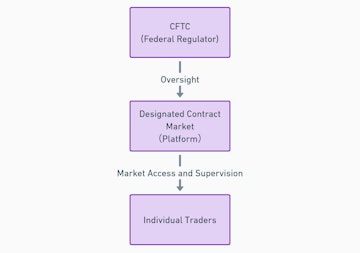
The key regulator is the Commodity Futures Trading Commission (CFTC), which oversees the exchanges that list and run event contracts. In practice, this usually means a prediction market platform is operating as a Designated Contract Market (DCM) - a federally regulated exchange structure.
That matters because the CFTC doesn’t regulate individual traders directly. Instead, it regulates the platform (DCM) that hosts the market, sets the rules, monitors trading, and handles settlement.
What Is a Designated Contract Market (DCM)?
A Designated Contract Market (DCM) is the CFTC’s term for a federally regulated exchange - the same category of legal entity used by major U.S. futures markets.
A DCM is not “a prediction app”. It’s an exchange that operates under the Commodity Exchange Act and must follow strict federal rules on how markets are listed, monitored, and settled.
Why DCM status matters to traders
If you’re a U.S. user, DCM status is one of the clearest signs that a platform is operating inside a recognized federal framework - not in a legal gray area.
A platform running as a DCM is expected to have:
- Market surveillance to detect manipulation and abusive trading
- Rule enforcement (including the ability to investigate and discipline bad actors)
- Clear contract specs so settlement isn’t arbitrary
- Defined dispute processes and compliance oversight
- Regulatory reporting and auditing obligations
That doesn’t mean the platform is “risk-free.” It means the marketplace is structured like a real exchange, with enforceable rules and a regulator watching the plumbing.
The Role of the Commodity Futures Trading Commission (CFTC)
The Commodity Futures Trading Commission is the federal agency that regulates U.S. derivatives markets under the Commodity Exchange Act. That includes futures, options, swaps - and, in certain cases, event contracts used in prediction markets.
Its role is not to “approve betting.” It oversees the exchanges themselves.
When a platform operates under CFTC oversight, it must:
- Register as a designated contract market (DCM) or similar regulated entity
- Follow federal reporting, surveillance, and compliance rules
- Maintain capital and operational standards
- Submit certain contracts for regulatory review
- Implement customer protections and anti-manipulation safeguards
In short, the CFTC regulates the marketplace infrastructure - not just the idea of the contract.
That regulatory structure is what separates federally compliant event-contract exchanges from offshore or unregistered platforms operating outside U.S. law.
It also means not every proposed contract is automatically permitted. The CFTC has authority to review, challenge, or prohibit contracts that may violate federal standards - particularly if they implicate gambling prohibitions or public-interest concerns.
Are Prediction Markets Considered Gambling?
To most users, prediction markets can feel like gambling: you put money down on an uncertain outcome and you either win or lose.
In U.S. law, however, the classification turns less on appearance and more on structure. The key questions are whether the product is offered as an event contract and whether it is listed on a federally regulated exchange framework overseen by the Commodity Futures Trading Commission (CFTC).
When an event contract is listed on a CFTC-regulated exchange, it sits in a federal derivatives framework with exchange obligations like market surveillance, rule enforcement, and protections against manipulation and abusive trading.
That’s why regulated event contracts are not automatically treated as state sportsbook wagering - even if the trade looks similar on your screen.
| Licensed Sportsbooks State gambling law & state licensing | CFTC-regulated prediction markets Federal commodities law & exchange oversight |
|---|---|
| Regulated by state gaming commissions and state statutes | Regulated federally by the Commodity Futures Trading Commission (CFTC) |
| Operator must hold a state sportsbook license | Venue operates as a regulated exchange structure (commonly a DCM) |
| Products are wagers offered by the sportsbook under state rules | Products are event contracts listed and traded on an exchange rulebook |
| Legality changes state by state depending on licensing and permitted bet types | Availability is national because the framework is federal |
| Enforcement is state-level (licensing, investigations, penalties) | Focuses on exchange obligations: rule enforcement, surveillance, anti-manipulation |
| Consumer protection comes from state betting regulations and dispute channels | Consumer protection comes from exchange controls and federal oversight of market integrity |
How Event Contracts Differ From Sports Betting
At the user-experience level, event contracts and sports betting can look similar:
- pick an outcome
- put money behind your view
- you win if you’re right
But legally and structurally, they’re not the same product. For a user, there are two practical differences that matter:
- Who you’re relying on to run a fair market
- Sports betting in the U.S. is typically offered by state-licensed operators under state gambling law. Each state decides what’s permitted, who can offer it, consumer safeguards, and enforcement.
- Event contracts are listed and traded on an exchange structure the CFTC regulates - with exchange rules, market surveillance, and formal compliance obligations built into how the marketplace operates.
- Who you are betting against
- A sportsbook’s economic model is usually operator vs customer - the operator sets lines and manages book risk.
- An exchange model is primarily customer vs customer through a marketplace operates by the exchange.
This is why “it looks like a bet” doesn’t settle the legal question by itself. The U.S. system draws lines based on market structure and statutory authority, not just appearance.
Why Federal Regulation Matters

Federal regulation matters because it changes your risk profile in predictable ways.
- The exchange has defined obligations to run a fair market
CFTC oversight of DCMs is built around core responsibilities such as maintaining market surveillance, enforcing rules, and deterring manipulation and abusive trading. This does not make trading risk-free, but it does mean the venue is expected to have real controls and accountability for market integrity. - Market rules and settlement standards are meant to be enforceable
A regulated exchange is expected to publish and enforce rulebooks, define contract terms clearly, and operate with recordkeeping and compliance standards. For traders, this matters most when there is a dispute, an unusual settlement question, or an allegation of market abuse. The framework is designed so the venue cannot treat settlement as discretionary or opaque. - Regulation draws boundaries around what can be listed
The Commodity Exchange Act includes an event contract provision that allows the CFTC to find certain event contracts contrary to the public interest, including contracts involving gaming and other specified categories. This matters because it creates a formal process through which controversial contract types can be reviewed and potentially restricted rather than left entirely to a platform’s business incentives.
Do State Gambling Laws Apply to Prediction Markets?
State gambling laws are the main rulebook for sportsbooks. They are not the main rulebook for federally regulated event contracts.
If a prediction market is operating through a CFTC-regulated exchange framework, the legal foundation starts with federal commodities law and the CFTC’s oversight of the exchange. That’s why a federally regulated platform can be available nationally even when sportsbook legality varies by state.
What state law still affects is the friction around categories that states view as wagering, particularly when contracts look and function like sports bets. In other words, state law isn’t the best first test for whether a federally regulated exchange can operate, but it is often the pressure point when a state thinks a specific product crosses into its gambling domain.
How states are challenging prediction markets right now
Over the past year, the most consistent pattern has been state-level pushback against sports-style event contracts. The state argument is straightforward: these contracts are effectively sports betting, and offering them without a state sportsbook license is unlawful in that state.
A few practical examples show how this plays out:
- Cease-and-desist orders and enforcement threats - State gaming regulators have sent letters ordering platforms to stop offering sports-related markets to residents, framing them as unauthorized sports wagering.
- Litigation in high-profile betting states - Nevada has gone to court seeking to block Kalshi’s sports contracts, arguing they amount to unlicensed sports wagering under Nevada law.
- Court fights over who has jurisdiction - In New Jersey, Kalshi obtained a preliminary injunction against the state’s attempt to enforce a cease-and-desist, illustrating the core dispute: state gambling authority versus federal exchange regulation.
At the moment, federally regulated prediction markets are generally still accessible to U.S. users nationwide, but ongoing litigation and regulatory review could change what products are offered, or where, over time.
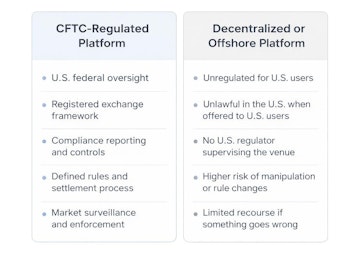
CFTC-Regulated Platforms vs Decentralized Prediction Markets
There are two broad categories of prediction market platforms U.S. users run into.
One category operates inside a federal regulatory framework, with an identifiable U.S. regulator and a supervised exchange structure. The other category typically operates outside that framework, often through blockchain-based systems that do not have U.S. exchange registration.
The difference matters because it changes the legal footing, the consumer-protection environment, and the stability of access.
Types of Prediction Markets Compared
What are Decentralized Platforms and how do they work?
Decentralized prediction markets are typically built on public blockchains. Instead of a U.S.-registered exchange running the marketplace, the platform relies on software rules for trading and settlement.
They are built around three moving parts:
- Smart contracts that create the market rules (what “Yes” means, what “No” means, how payouts work).
- Trading mechanisms (often an AMM or onchain order book) that let users buy/sell outcome exposure without a central operator matching every trade.
- Oracles that bring the real-world result onchain so the contract can settle.
From a user’s perspective, the appeal is that payouts can be automated and the market can keep operating without a single centralized operator approving every action.
From a legality perspective, however, the key point is simpler: these platforms often do not operate inside the CFTC’s registered exchange framework and are considered illegal.
The CFTC has repeatedly brought cases over illegal, off-exchange binary options offered to U.S. customers, and the SEC and CFTC have jointly warned consumers about fraud risks around binary options platforms.
What Makes a Platform Federally Regulated?

Becoming a DCM is not a quick formality.
That status is not just a label you slap on a website. It is a formal regulatory designation under the Commodity Exchange Act, which requires a platform to meet federal standards for running an exchange, and comes with a significant number of ongoing obligations.
In practical terms, a regulated exchange is expected to have:
- Published market rules and contract specifications that are clear enough to enforce.
- Market surveillance designed to detect manipulation and abusive trading.
- Processes for enforcing rules and disciplining misconduct.
- Compliance and reporting obligations tied to federal oversight expectations.
Those are reasons regulated status is meaningful to a user. It is hard to obtain because it is not just about listing contracts - it is about running a fully supervised, transparent marketplace with enforceable rules.
Legal Risk Differences for U.S. Users
For U.S. users, the risk difference is not mainly about whether you can place a trade today. It is about what happens when regulation, enforcement, or disputes arise.
CFTC-regulated platforms
- Legal clarity: you’re using a platform that operates under U.S. federal oversight, not a workaround.
- Rules you can rely on: published contract terms, defined settlement, and enforceable market rules.
- Real safeguards: surveillance and enforcement programs designed to reduce manipulation and abusive trading.
Decentralized or offshore platforms
- Unlawful in the U.S.: if offered to U.S. users without required registration, it’s outside U.S. legal authorization.
- No real protection: no U.S. regulator supervising the venue, so if you get burned, you’re largely on your own.
- Higher failure risk: sudden rule changes, settlement disputes, or platform issues can leave you with limited recourse.
Can You Legally Make Money on Prediction Markets?
Yes. Making money is not what determines legality. What matters is whether you are trading on a platform and contracts that are lawfully offered to U.S. users under the regulated framework.
If you stay on the CFTC-regulated lane, making money is simply the result of a successful trade, much like when you trade stocks, options, or other regulated markets.
Profit Legality
If you trade on a CFTC-regulated platform operating inside the U.S. federal exchange framework, profits from those trades are lawful in the same way profits from other regulated trading activity are lawful.
What most people are really asking here is: could I get in trouble just for winning?
The answer is that profit itself is not the trigger. The risk comes from using platforms or products that are not legally authorized for U.S. users. If you stay in the regulated lane, you’re not doing something illegal simply because you made money.
Tax Considerations
Legal does not mean tax-free.
If you make money trading prediction market contracts, you should assume it may be taxable. Keep records of deposits, withdrawals, trades, fees, and your net results so you can report accurately.
For a deeper understanding of how prediction market profits are taxed, read our full breakdown: How Are Prediction Market Winnings Taxed?

Marcus has spent over 20 years navigating the legal side of online betting - from his early days consulting for offshore operators to helping licensed U.S. sportsbooks launch in regulated markets. He’s worked with compliance teams, reviewed licensing frameworks in 15+ states, and advised on some of the biggest regulatory shifts since PASPA was repealed.
At BettingScanner, Marcus serves as the voice of reason - translating legalese into plain English and helping bettors understand what’s legal, what’s risky, and where the gray areas live. If you’re ever unsure about the rules, Marcus is your man - as he probably helped write them.
Prediction Market Legality FAQs
If you are using a CFTC-regulated event contract exchange, access is generally nationwide because the legal framework starts with federal commodities regulation and CFTC oversight of the exchange.
State challenges are currently concentrated on sports-style markets, and those disputes could affect what is offered over time, but regulated prediction markets remain broadly available today.
Check for evidence of CFTC-regulated exchange status, such as an Order of Designation as a Designated Contract Market or an official CFTC listing/announcement.
For example, the CFTC publishes designation announcements for DCMs.
Yes - but sports event contracts are the most contested category right now. Even when offered through the regulated lane, they are attracting state enforcement actions from state authorities and court fights about whether they resemble state-regulated sports betting.
So while they are currently available and perfectly legal to trade on at the time of this writing, their legality status could change in the future based on ongoing litigations.
Yes. Sports betting legality is state-by-state licensing. Federally regulated event contracts operate under a federal exchange framework overseen by the CFTC.
That difference is why access can be broader than sportsbook legality in some cases.
CFTC-regulated exchanges are required to run market surveillance, enforce rules, and meet ongoing compliance standards under CFTC oversight. That is different from a platform simply claiming it has rules.
If you are using a CFTC-regulated event contract exchange, the legal basis is federal commodities law and CFTC oversight of the exchange, not your state’s sportsbook licensing rules. That is why these platforms can still be lawful and usable for customers even when a state gaming regulator objects.
Many states are actively challenging sports-style event contracts right now, and courts are being asked to decide where the line is between state gambling enforcement and federally regulated event contracts. As those lawsuits play out, what’s available could change over time, especially around sports markets.
Yes. For U.S. users, CFTC-regulated prediction markets are the safer option for three simple reasons:
- They operate in the open under a U.S. regulator and a regulated exchange framework, with rulebooks, surveillance expectations, and enforceable market rules.
- If something goes wrong, there is an actual U.S. oversight chain above the venue. With offshore sites, you usually have no meaningful regulator to complain to and no realistic path to recover funds if withdrawals get blocked or terms change.
- U.S. regulators have a long track record of treating unregistered event-based and binary-style offerings as illegal when they’re offered to U.S. customers, which is exactly the risk profile offshore and unregulated platforms sit in.
Yes, political prediction markets can be legal in the U.S. when they are offered as event contracts through the CFTC-regulated lane.
This is also why they feel unusual to U.S. bettors: regulated sportsbooks in the U.S. generally do not offer political betting, even in states where sports betting is legal. Political markets show up in prediction markets because they are treated under a different federal framework than state sportsbook rules.
No. Regulation does not eliminate trading risk.
What it changes is the structure: the venue is expected to have surveillance, enforce rules, and run a defined settlement process, which reduces certain types of bad behavior and makes outcomes less arbitrary.


